Defence finance, capital & M&A
Financing Europe's rearmament has moved from a marginal question to a central one, and the terms on which capital reaches defence firms are changing faster than the headlines about budgets suggest. The analyses gathered under this theme follow the money itself: where it originates, who bears the credit risk, and the conditions attached before it is committed.
They look at the public and quasi-public channels first — the SAFE instrument's loans routed through member states, the European Investment Bank's decision to widen its defence and security-related lending, and the national promotional banks (among them KfW, Bpifrance, Cassa Depositi e Prestiti, Bank Gospodarstwa Krajowego and ICO) that are being asked to finance production and dual-use capacity their mandates once kept at arm's length. Each route carries its own eligibility test, its own definition of what counts as defence, and its own limit on how far a public balance sheet will go.
The private side is treated with the same care. The reports distinguish equity from debt and ownership from control; they examine how exclusion and ESG policies that once screened defence out are being rewritten, how mergers and acquisitions reshape who owns critical capacity, and how guarantees, subordinated instruments and off-take commitments allocate risk between the state, the lender and the firm. Where a figure is decisive it is tied to its source — a regulation, an institution's own disclosure or an official statement — and where a claim cannot be verified it is marked as such. The aim is a reader who can see not just that money is available, but on what terms, from whom, and against what security.
Reports in this theme (55)
Strategic Investment in Resilient INS/PNT Navigation Systems in the EU
Proposed EU PNT ecosystem integrating conventional GNSS (Galileo) with emerging alternative PNT sources, including terrestrial timing networks and on-board sensors, to enhance overall resilience.
View report →
Liability and Default in European Defence Fund Consortia
On 2 October 2026 the European Commission reported that its 2026 European Defence Fund calls had drawn 612 proposals for an envelope of EUR 1.006 billion.
View report →
The Financial Architecture of European Rearmament
Over the past decade, and particularly after the Russian invasion of Ukraine in 2022, the central question in European defence policy has shifted from the level of defence spending to the structure of defence financing.
View report →
Non-Transfer Restrictions on EU-Funded Defence R&D in European Defence M&A
In European defence transactions, intellectual property is often assessed as an ordinary asset class: counsel verifies ownership, traces chain of title, reviews licences, and tests change-of-control consequences under…
View report →
Recovering Public Investment in Defence Technology
European governments frequently finance defence technology before a product has a commercial market beyond the original military requirement.
View report →
The Transformation of Defence into a Financial Sector
Over the past decade, the European defence sector has undergone a structural transformation in how it is perceived within global capital markets.
View report →
Private Capital, Public Ownership and Risk Across Three Military-Campus PPPs
Permanent forward defence is a fiscal commitment before it is a military one.
View report →
The Cash Behind Europe’s Defence Technology
When Norway’s Defence Materiel Agency awarded Clavister the Tactical Core Network System contract in January 2026, the total value was put at approximately SEK 280 million.
View report →
Pension Obligations and Capital Allocation in European Defence
On 10 July 2025 the insurer Rothesay took over all of Thales’s commitments under the Thales UK Pension Scheme, completing a transfer that Thales had begun in December 2023 with a net cash outflow of £850 million.
View report →
Subordinated Capital in France’s Defence Supply Chain
On 22 September 2026 Groupe BPCE launched an eight-year participatory loan for French defence suppliers, with four years before any principal is repaid, no security over company assets and a partial guarantee from the…
View report →
Procurement Lock-Out in European Defence: Mechanisms, Capability Costs, and Capital Effects
The European defence market is often described in terms of concentration, with a small group of prime contractors capturing the majority of procurement volume.
View report →
The EU Programme-Access Premium in European Defence M&A
European defence M&A is entering a phase in which value can no longer be assessed only through technology, backlog, manufacturing capacity, customer access, or export-control compatibility.
View report →
Private Equity and Dual-Use Tech in Europe Since 2022
European security policy has undergone a paradigm shift since 2022, driven by the war in Ukraine and heightened geopolitical tensions.
View report →
Britain’s Defence Investment Plan: From Ten-Year Intent to Contractable Demand
Britain’s Defence Investment Plan seeks to translate the strategic commitments of the 2025 Strategic Defence Review into a ten-year framework for expenditure, procurement, industrial capacity and technological…
View report →
The Osborne Yard's Three Financial States
On 24 July 2026 the Commonwealth announced a further A$4.6 billion investment in Australian Naval Infrastructure for the Nuclear-Powered Submarine Construction Yard at Osborne, bringing the Government’s contribution to…
View report →
Compensation, Contractual Precedence and Financial Exposure in France, Sweden and the Union Framework
European defence mobilisation runs through industrial capacity that is privately owned, privately financed and embedded in ordinary commercial relationships until the moment public authority requires it.
View report →
Cash and Capital in Europe’s Shared Defence Companies
In 2025 Airbus and Leonardo together received €523 million of dividends from MBDA, more than the €361 million of MBDA profit they recognised between them, while Leonardo owed the missile group €1.553 billion at the…
View report →
Household Capital and the Public Anchor in Bpifrance Défense
Europe’s attempt to draw household savings into defence capital rests on a proposition that sounds simple and is not: that private savings can supplement public expenditure.
View report →
Defence Plant Acquisitions and the Continuity of Authorisations
On 11 October 2022 a prefectoral order recorded the change of operator at the nitrocellulose installations of the Bergerac industrial platform, where EURENCO succeeded MANUCO, a company it had acquired and then absorbed…
View report →
Dual-Use by Design or by Default?
The European Union has moved rapidly from treating semiconductors as a supply-chain vulnerability exposed by the 2020–2022 shortage to framing them as a strategic asset embedded in technological sovereignty and defence…
View report →
The STEP Sovereignty Seal in the EU Industrial and Financial Architecture
The STEP Sovereignty Seal is constructed within EU law as a Commission-awarded quality label assigned to project proposals that both contribute to STEP objectives and meet minimum evaluation thresholds under specific…
View report →
AGILE and the Structural Gap in European Defence Innovation Finance
The creation of AGILE does not primarily signal the addition of a new funding instrument, but the formal recognition of a structural inefficiency within the European defence innovation system.
View report →
The Human Capital Crisis in European Defence
The return of large-scale war to Europe and the acceleration of NATO and EU defence ambitions have made one point increasingly difficult to ignore: higher spending does not automatically produce usable military…
View report →
When Biotech Becomes Defence-Finance Relevant
Biotechnology is increasingly entering the security perimeter of European and Allied institutions, but not every healthcare innovation belongs inside a defence-finance framework.
View report →
University Licence Terms and Defence Spin-out Finance
On 10 July 2025 ETH Zurich brought into force an equity and licensing policy under which it takes, as a rule, a 2% stake in every spin-off incorporated as a stock corporation, and publishes three standard licence…
View report →
Germany’s Defence Cost Rules and Investment Recovery
Germany’s defence expansion creates a financing question that cannot be answered from procurement volumes alone.
View report →
The Economic, Financial and Regulatory Function of the STEP Sovereignty Seal in Mobilising Private Capital and Institutional Lending for the EU Defence, Dual-Use and Strategic Technology Ecosystem
The European Union has progressively recognised that the central constraint in scaling strategic technologies—particularly in defence and dual-use domains—is not limited to technological capability or policy intent, but…
View report →
European Pension Funds and Defence Post-2024 ESG Reinterpretation and the Gradual Reopening of Institutional Capital
The relationship between European pension funds and the defence sector has historically been framed through exclusion, grounded in ESG constraints and reputational risk.
View report →
National Promotional Banks and Europe’s Defence-Finance Gap
Europe’s defence-finance architecture is expanding, but it remains structurally uneven.
View report →
The Capital Sovereignty Problem in European Defence-Tech
European defence-tech has crossed a structural threshold.
View report →
The Evolving Integration of Defense in the EU’s ESG Framework
In the wake of growing geopolitical instability – most notably the war in Ukraine – European policymakers and investors are rethinking the relationship between defense and sustainable finance.
View report →
Cash Returned, Capacity Required
On 21 July 2026 Airbus SE announced that its Board of Directors had approved a share buyback programme of €5 billion over three years , alongside a 2029 target of €12 billion to €13 billion of EBIT Adjusted and a…
View report →
When Accelerated Deductions Can Support Equipment Investment Before Qualified Production
A German component supplier that decides to serve the defence market faces an interval with a characteristic shape.
View report →
How REACH authorisation, customer qualification and a pending restriction shape supplier access and industrial investment
A European treatment shop that applies a chemical conversion coating to an aluminium component for an aircraft engine, a landing gear actuator or a heat exchanger is operating inside two control systems at once, and the…
View report →
How acquisition finance preserves cash, creates refinancing claims and transfers repayment into equity
A European defence company that announces a capital raise has told its investors almost nothing about what it can now build.
View report →
NATO Infrastructure Finance: Lessons from Lielvārde and Powidz
When a new runway apron, fuel depot or passenger terminal opens on a European air base, people usually call it a NATO project, and they are rarely wrong.
View report →
Italy’s Defence Capital Architecture
Italy’s defence-finance problem cannot be reduced to a simple question of whether the country spends more or less than its European peers.
View report →
Defence M&A and Geopolitical Risk: A Strategic Finance Perspective
Europe’s defence policy has entered a new phase of structural transformation.
View report →
The Commission’s Defence-Specific Use of the EIC Equity Architecture
The European Innovation Council is not a new entrant to equity investing.
View report →
EU Defence Finance Stack 2025–2030
The European defence-finance landscape has entered a new phase.
View report →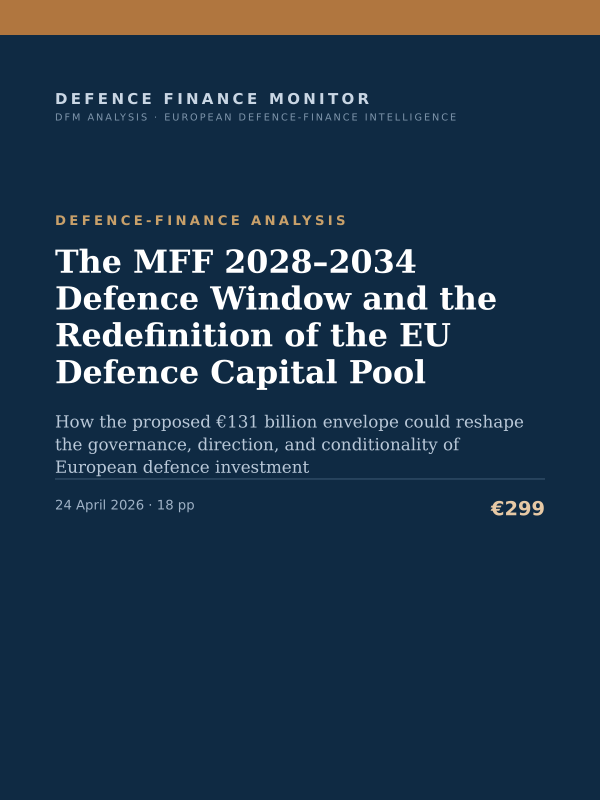
The MFF 2028–2034 Defence Window and the Redefinition of the EU Defence Capital Pool
Introductory paragraph: The central issue is not whether the European Union is becoming the main payer of European defence in sheer fiscal volume.
View report →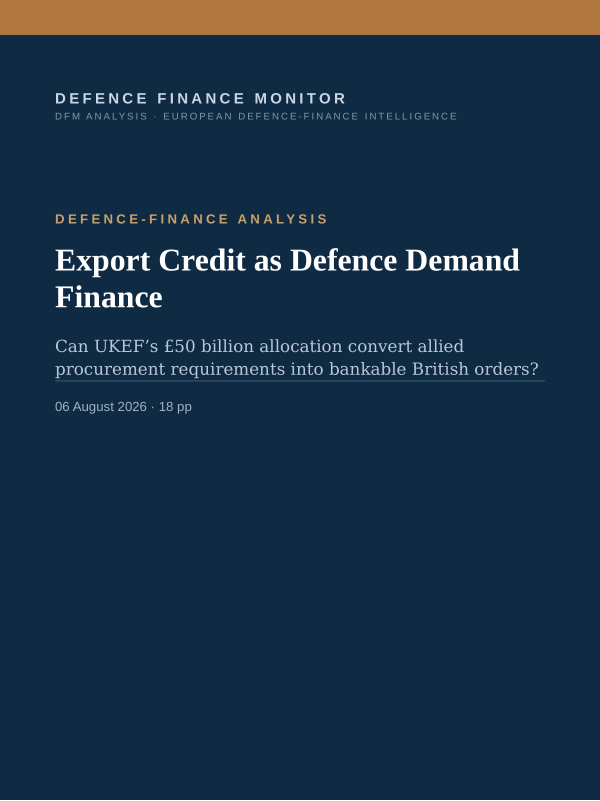
Export Credit as Defence Demand Finance
UKEF’s new £50 billion Defence Export Fund matters because sovereign defence procurement is constrained less often by the availability of technologies than by the availability of acceptable finance.
View report →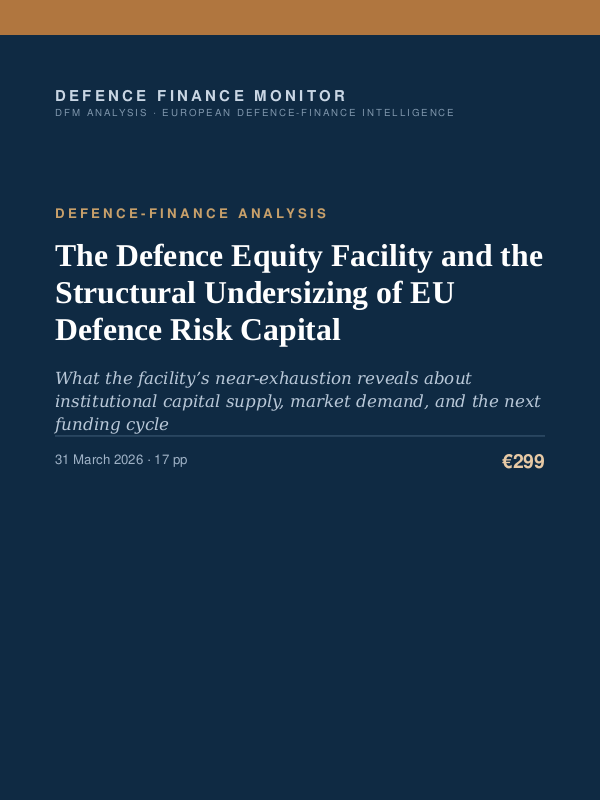
The Defence Equity Facility and the Structural Undersizing of EU Defence Risk Capital
The Defence Equity Facility was conceived as a four-year instrument to help build a durable European market for defence innovation finance.
View report →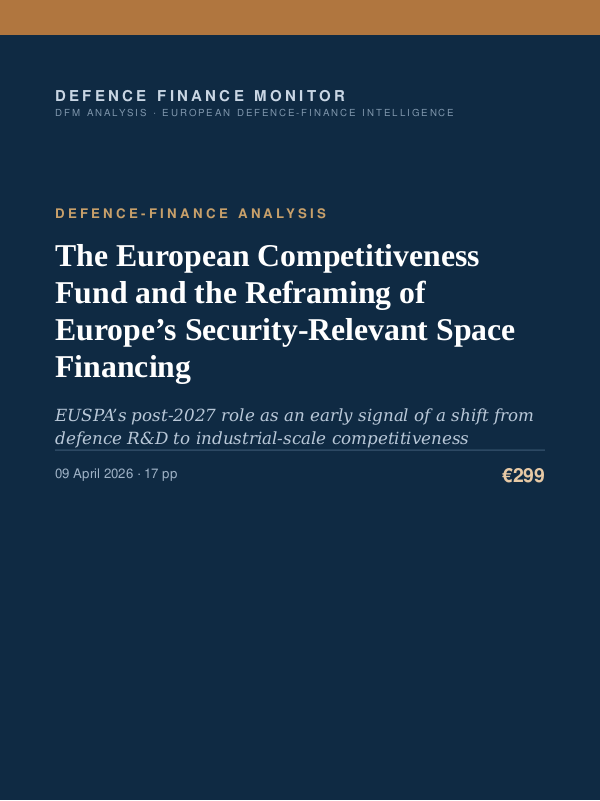
The European Competitiveness Fund and the Reframing of Europe’s Security-Relevant Space Financing
Europe has already built a dense and operational space architecture with direct relevance to security and defence, spanning secure connectivity, Earth observation, navigation, and space surveillance.
View report →
THE CAPITAL RE-ARMAMENT: Banking, Public Finance and Private Credit for Defence Industrial Readiness
In the decade preceding 2022, Europe’s defence financing was characterised by restraint, institutional fragmentation and a deliberate separation between supranational financial instruments and the military-industrial…
View report →
The New Transatlantic Defence Architecture: Integrating ReArm Europe, NATO DIANA & Industrial Finance
While capital markets digest the new sovereign guarantees, a parallel revolution just occurred in Brussels and Norfolk.
View report →
Autonomous Swarms in NATO and EU Defence: Development, Integration, and Investment
Uncrewed autonomous systems – in the air, on land, and underwater – have rapidly become essential elements of modern warfare, and their role is poised to expand dramatically in the coming years.
View report →
The Defence Equity Facility and the New Public Anchor for European Defence Capital
Europe’s defence-finance problem is no longer confined to public budgets.
View report →
The Emerging Structure of the European Defence M&A Market
The European defence M&A market is entering a more consequential phase, but it is not yet a fully transparent or standardised market.
View report →
Capital Capture versus Ecosystem Building in European Defence
European defence is entering a new financing cycle shaped by SAFE, EDF, EDIP, national rearmament plans and the expanding role of public financial institutions.
View report →
Mapping the Capital Gaps in the EU Defence Build-Up
Russia’s invasion of Ukraine in 2022 triggered a historic surge in EU defence spending.
View report →
The Prime Contractor as Venture-Capital Gatekeeper
On 21 July 2026, at the Farnborough International Airshow, Airbus Defence and Space signed an agreement to become the anchor investor in E2D, a European dual-use and defence technology growth fund launched a month…
View report →
The European Defence Equity Rerating Decomposed
European defence equities have already undergone an exceptional repricing, but the central analytical problem has now changed.
View report →
The Public Mandate Register: Investment Banks in European Defence M&A
European defence consolidation is visible in assets, platforms and strategic-industrial policy, but the advisory infrastructure behind those transactions is harder to measure.
View report →
Triple-Layer Foreign Investment Compliance for Defence M&A
European defence M&A is no longer governed by a single regulatory question.
View report →Long reports · updated editions
National promotional banks and defence: how KfW, Bpifrance, CDP, BGK and ICO finance Europe's rearmament
For most of their history, Europe's national promotional banks kept defence at arm's length.
View report →