Capability
The Defence Equity Facility and the Structural Undersizing of EU Defence Risk Capital
What is the Defence Equity Facility, and what was its original four-year mandate and scale?
The Defence Equity Facility was conceived as a four-year instrument to help build a durable. Defence-finance analysis; 17-page sourced DFM PDF report.
This public thread presents the concise analytical answer. The complete evidence, source base and assessment are available below.
Part of our Investors & Capital Allocators and Policy, Procurement & Institutions coverage →
Original DFM publication · DFM Analysis report · 2026-03-31
The Defence Equity Facility was conceived as a four-year instrument to help build a durable European market for defence innovation finance. Its actual deployment path suggests a different reality. By reaching near-full commitment well before its scheduled end date, the facility has ceased to be only a support mechanism and has become a diagnostic instrument.
It now provides concrete evidence that the institutional supply of EU-backed risk capital for defence is materially smaller than the volume of eligible market demand it is expected to serve. The issue, therefore, is not whether the DEF exists, but whether its original scale was ever proportionate to the ecosystem it was meant to anchor.
This analysis answers: What is the Defence Equity Facility, and what was its original four-year mandate and scale? What does near-full commitment well before the scheduled end date reveal about EU-backed risk-capital supply versus eligible demand? What are the implications for fund managers, defence innovators and institutional actors? Which signals indicate whether the facility was ever proportionate to the ecosystem it was meant to anchor?
Key takeaways
- The issue, therefore, is not whether the DEF exists, but whether its original scale was ever proportionate to the ecosystem it was meant to anchor.
Choose how to continue
Go deeper on this question
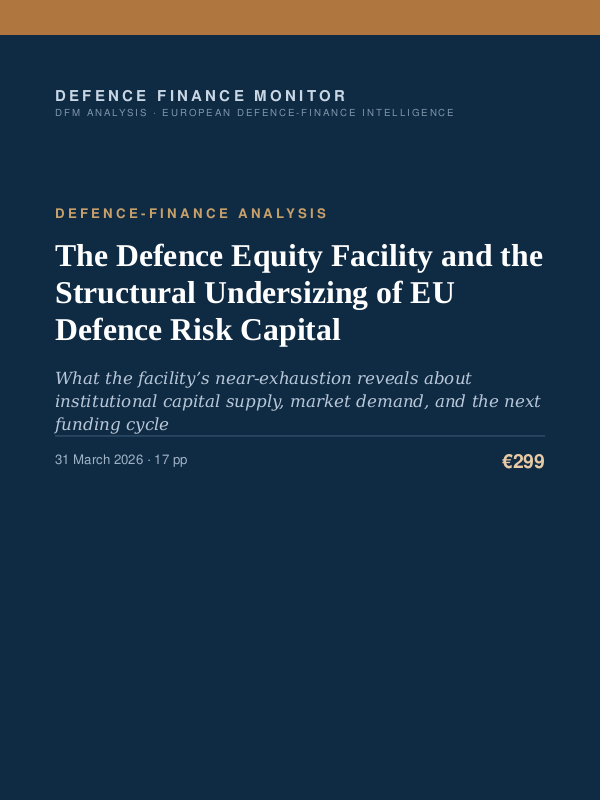 Full sourced report
The Defence Equity Facility and the Structural Undersizing of EU Defence Risk Capital
View the report →
Full sourced report
The Defence Equity Facility and the Structural Undersizing of EU Defence Risk Capital
View the report →
Keep getting the analysis
DFM publishes new defence-finance analysis every week.
Original DFM analysis
The Defence Equity Facility and the Structural Undersizing of EU Defence Risk Capital
The publication details above identify the source used for this public thread.
FAQ
What is The Defence Equity Facility and the Structural Undersizing of EU Defence Risk Capital?
Its actual deployment path suggests a different reality.
Who can access The Defence Equity Facility and the Structural Undersizing of EU Defence Risk Capital, and who does it apply to?
It now provides concrete evidence that the institutional supply of EU-backed risk capital for defence is materially smaller than the volume of eligible market demand it is expected to serve.
Related DFM Platform threads
- Europe's High-Low Arsenal: $50.66bn Pledged to Deep Strike, and the Magazine No Public Record Sets
- UK's £400k Strike Weapon vs the $4m PAC-3 MSE: Why Cheap Autonomy Forces Europe to Buy More Layers, Not Fewer
- PAC-3, SAMP/T and Europe's Missile Constraint: Can Cheap Unmanned Mass Substitute for the Expensive Upper Layer?
Explore this category Strategic Autonomy
Professional requests (internal interest signal — not a marketplace; nothing is charged or promised)
See Professional & Institutional Access — plans, group/institutional seats and contact →
Defence Finance Monitor is an analytical and informational product. It does not constitute investment advice, financial advice or a recommendation to buy or sell securities. Subscriptions run on DFM Analysis. Payments for Professional Packs are processed securely by Stripe at checkout.