Capability
Fifty Billion Pounds of Capacity Is Not an Order Book
Polish programme, wartime Ukrainian exposure carrying a billion-pound modelled loss — absorb a realised failure without breaking the political consensus that lets ministers keep overriding normal risk limits?
In June 2026 London attached a £50 billion defence export facility to its Defence Investment Plan, billed as the biggest enlargement of UK Export Financ…
This public thread presents the concise analytical answer. The complete evidence, source base and assessment are available below.
Part of our Policy, Procurement & Institutions and Research, Universities & Deep Tech coverage →
Original DFM publication · DFM Analysis report · 2026-08-06
Analysis as of 6 August 2026.
In June 2026 London attached a £50 billion defence export facility to its Defence Investment Plan, billed as the biggest enlargement of UK Export Finance in the agency's century of existence. The premise behind it is sound: when governments buy weapons abroad, what stalls a deal is rarely the hardware and frequently the terms on which the purchase can be financed. A state guarantor that lets an exporter collect cash up front while a sovereign buyer repays over a decade changes what is achievable. But the sheer scale of the headline invites a category error. UKEF wrote £14.5 billion of new support in 2024/25, its best year on record, and its peak exposure that year reached £58.8 billion. The new allocation exceeds three record years of issuance combined. Capacity of that size is a political signal; it is not, by itself, demand.
The arithmetic around the announcement is a stack of non-equivalent numbers. The 2026 Act on industry and export assistance lifted the statutory ceiling to £160 billion in sterling terms, roughly double the prior limit of 82,700 million special drawing rights (about £84 billion). Treasury consent caps the ordinary portfolio at £80 billion. The public capacity headline after the defence allocation is £130 billion. Direct lending runs to £13 billion, £3 billion of it reserved for defence. Each figure is governed by a different instrument, and none counts signed contracts or disbursed cash. The sharpest fact in the record cuts against the headline: in 2025/26, the year statutory room doubled, issuance fell to just over £11 billion. Authorisation and activity moved in opposite directions.
What the disclosed transactions show is an instrument that works selectively and at sovereign scale. Poland's NAREW air-defence programme produced a £7.698 billion guarantee, booked through the National Interest Account after ministers exceptionally raised the country's risk appetite to £15 billion — political direction substituting for ordinary underwriting. Ukraine's missile purchase from Thales moved from announcement to recorded exposure in roughly fifteen months, with a maximum liability of £1.854 billion against the £1.6 billion headline and, more strikingly, a disclosed expected loss of £1,176 million at the moment the facility went live. Indonesia's £128 million submarine-rescue deals brought J.P. Morgan and Santander into the structure, showing banks willing to lend once sovereign risk is transformed. Qatar's £5 billion Typhoon package from 2018 still weighs on the exceptional-risk account seven years on. The pattern is consistent: long tails, ministerial discretion at the margin, and a buyer-side logic that equity capital cannot replicate.
The mechanism also has hard limits that money does not touch. A financed deal must still clear export licensing, must carry enough genuine UK economic content, and must find an exporter with factories able to deliver. The content rules are wider than intuition suggests — a Korean FA-50 package and an MBDA France sale to Indonesia both qualified because the British contribution was documented — but they are rules, not formalities. Concentration compounds the fragility: three customers generated over 60 per cent of net premium income (£277 million), and a single Polish programme drove most of the threefold jump in exceptional-risk exposure. A conversion cycle of one to two years sits on top of a risk-carrying cycle measured in decades, so verdicts will arrive slowly.
Two carrying questions organise what remains unknown. First, will issued defence business over the next three financial years rise in step with the enlarged capacity, or will the 2025/26 divergence persist and reveal that the binding constraint lies in licensing throughput, content documentation or industrial capacity rather than in finance at all? Second, can a portfolio this concentrated — a few system houses, one dominant Polish programme, wartime Ukrainian exposure carrying a billion-pound modelled loss — absorb a realised failure without breaking the political consensus that lets ministers keep overriding normal risk limits?
Choose how to continue
Go deeper on this question
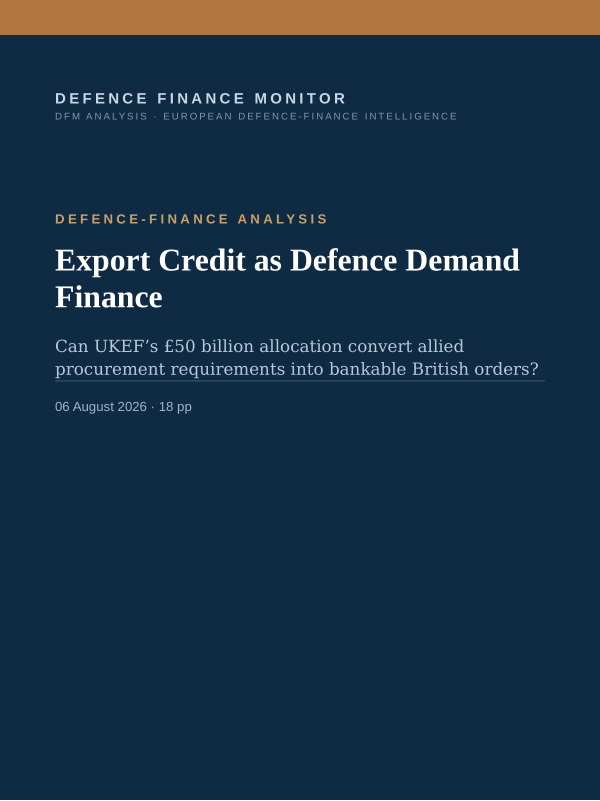 Full sourced report
Export Credit as Defence Demand Finance
View the report →
Full sourced report
Export Credit as Defence Demand Finance
View the report →
Keep getting the analysis
DFM publishes new defence-finance analysis every week.
Original DFM analysis
Export Credit as Defence Demand Finance
The publication details above identify the source used for this public thread.
Related DFM Platform threads
- Europe's High-Low Arsenal: $50.66bn Pledged to Deep Strike, and the Magazine No Public Record Sets
- UK's £400k Strike Weapon vs the $4m PAC-3 MSE: Why Cheap Autonomy Forces Europe to Buy More Layers, Not Fewer
- PAC-3, SAMP/T and Europe's Missile Constraint: Can Cheap Unmanned Mass Substitute for the Expensive Upper Layer?
Explore this category Strategic Autonomy
Professional requests (internal interest signal — not a marketplace; nothing is charged or promised)
See Professional & Institutional Access — plans, group/institutional seats and contact →
Defence Finance Monitor is an analytical and informational product. It does not constitute investment advice, financial advice or a recommendation to buy or sell securities. Subscriptions run on DFM Analysis. Payments for Professional Packs are processed securely by Stripe at checkout.