Capability
Triple-Layer Foreign Investment Compliance for Defence M&A
What are the three EU review layers (Foreign Subsidies Regulation, EU FDI screening, outbound investment monitoring) that a defence M&A deal may trigger simultaneously?
Triple-Layer Foreign Investment Compliance for Defence M&A: European defence M&A is no longer. Defence-finance analysis; 15-page sourced DFM PDF report.
This public thread presents the concise analytical answer. The complete evidence, source base and assessment are available below.
Part of our Legal, Regulatory & Advisory and Investors & Capital Allocators coverage →
Original DFM publication · DFM Analysis report · 2026-06-05
European defence M&A is no longer governed by a single regulatory question. A cross-border transaction involving defence, dual-use, cyber, space, AI, quantum, semiconductors or critical infrastructure may now trigger several distinct forms of state review at the same time.
The Foreign Subsidies Regulation examines whether non-EU financial support distorts the internal market; the EU FDI framework and national screening regimes assess risks to security and public order; and the emerging outbound investment monitoring framework introduces a further layer around technology leakage, know-how transfer and strategic dependency.
This analysis answers: What are the three EU review layers (Foreign Subsidies Regulation, EU FDI screening, outbound investment monitoring) that a defence M&A deal may trigger simultaneously? How do these instruments differ in perimeter, and how does national divergence complicate cross-border transactions? What deal consequences follow from the comparative perimeter across defence, dual-use, cyber, space, AI, quantum and semiconductors? What compliance implications and strategic-dependency risks does the triple-layer regime create for defence investors?
Choose how to continue
Go deeper on this question
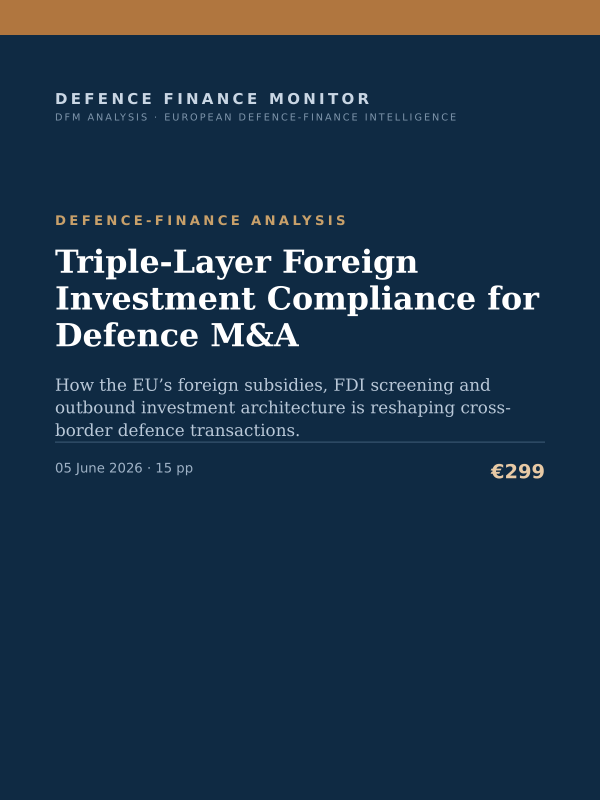 Full sourced report
Triple-Layer Foreign Investment Compliance for Defence M&A
View the report →
Full sourced report
Triple-Layer Foreign Investment Compliance for Defence M&A
View the report →
Keep getting the analysis
DFM publishes new defence-finance analysis every week.
Original DFM analysis
Triple-Layer Foreign Investment Compliance for Defence M&A
The publication details above identify the source used for this public thread.
FAQ
What is Triple-Layer Foreign Investment Compliance for Defence M&A?
A cross-border transaction involving defence, dual-use, cyber, space, AI, quantum, semiconductors or critical infrastructure may now trigger several distinct forms of state review at the same time.
Who can access Triple-Layer Foreign Investment Compliance for Defence M&A, and who does it apply to?
The Foreign Subsidies Regulation examines whether non-EU financial support distorts the internal market; the EU FDI framework and national screening regimes assess risks to security and public order…
Related DFM Platform threads
- Europe's High-Low Arsenal: $50.66bn Pledged to Deep Strike, and the Magazine No Public Record Sets
- UK's £400k Strike Weapon vs the $4m PAC-3 MSE: Why Cheap Autonomy Forces Europe to Buy More Layers, Not Fewer
- PAC-3, SAMP/T and Europe's Missile Constraint: Can Cheap Unmanned Mass Substitute for the Expensive Upper Layer?
Explore this category Strategic Autonomy
Professional requests (internal interest signal — not a marketplace; nothing is charged or promised)
See Professional & Institutional Access — plans, group/institutional seats and contact →
Defence Finance Monitor is an analytical and informational product. It does not constitute investment advice, financial advice or a recommendation to buy or sell securities. Subscriptions run on DFM Analysis. Payments for Professional Packs are processed securely by Stripe at checkout.