Capability
Agile And The Structural Gap In European
Agile and the Structural Gap in European: what capability does it address, and how mature is it?
The creation of AGILE does not primarily signal the addition of a new funding instrument, but the formal recognition of a structural inefficiency within the European defence innovation system.
This public thread presents the concise analytical answer. The complete evidence, source base and assessment are available below.
Part of our Policy, Procurement & Institutions and Defence & Dual-Use Companies coverage →
Platform publication · DFM Analysis report · 2026-07-03
The creation of AGILE does not primarily signal the addition of a new funding instrument, but the formal recognition of a structural inefficiency within the European defence innovation system. Despite the existence of substantial EU-level funding, notably through the European Defence Fund, firms operating at high technology readiness levels continue to face persistent barriers when attempting to transition from functional prototypes to validated, deployable capabilities. This bottleneck emerges at the precise moment when capital is most time-sensitive and operational credibility must be established through testing, certification, and integration. The difficulty is not the absence of funding in aggregate terms, but the incompatibility between the institutional architecture of existing programmes and the requirements of fast-moving, single-technology innovators operating under compressed innovation and survival timelines.
The report is structured as a progressive reconstruction of this mismatch and of the corrective logic embedded in AGILE. It begins with a detailed analysis of the European Defence Fund Interim Evaluation, identifying the specific structural constraints affecting SMEs and start-ups, including administrative burden, consortium requirements, co-financing dependencies, and long award cycles. It then examines why instruments such as EUDIS, while relevant as entry mechanisms, do not resolve late-stage financing constraints. A central section analyses AGILE as an institutional response, focusing on its design features and their implications for funding logic, speed, and procurement linkage.
Subsequent sections position AGILE within the broader EU defence innovation stack, analyse its connection to the Defence Industry Transformation Roadmap and the White Paper for European Defence – Readiness 2030, and assess the implications of Ukraine’s potential association. The report concludes by evaluating AGILE as a pilot for the next Multiannual Financial Framework and as a signal of an emerging shift toward a more speed-sensitive, adoption-oriented model of European defence innovation finance.
Key takeaways
- Subsequent sections position AGILE within the broader EU defence innovation stack, analyse its connection to the Defence Industry Transformation Roadmap and the White Paper for European Defence – Readiness 2030…
- It then examines why instruments such as EUDIS, while relevant as entry mechanisms, do not resolve late-stage financing constraints.
- The report concludes by evaluating AGILE as a pilot for the next Multiannual Financial Framework and as a signal of an emerging shift toward a more speed-sensitive…
Choose how to continue
Go deeper on this question
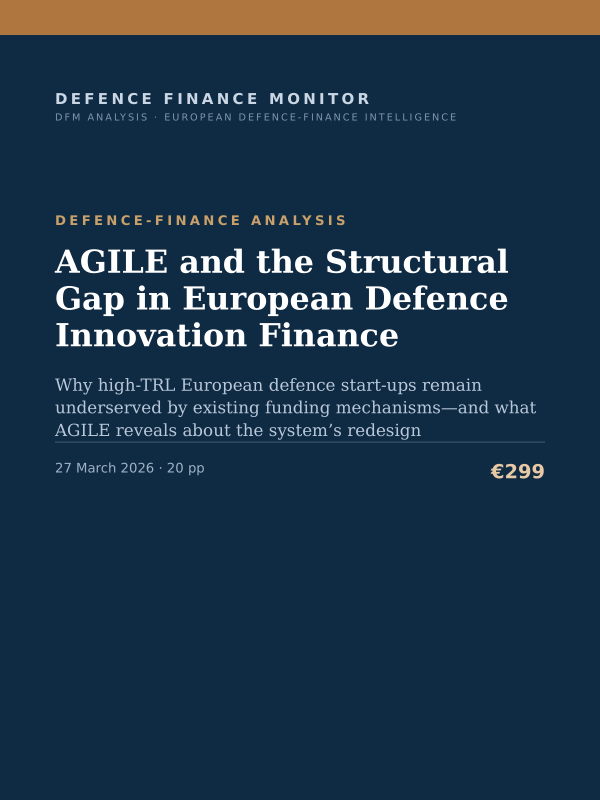 Full sourced report
AGILE and the Structural Gap in European Defence Innovation Finance
View the report →
Full sourced report
AGILE and the Structural Gap in European Defence Innovation Finance
View the report →
Keep getting the analysis
DFM publishes new defence-finance analysis every week.
Original DFM analysis
Agile And The Structural Gap In European
The publication details above identify the source used for this public thread.
FAQ
What is Agile And The Structural Gap In European?
The report is structured as a progressive reconstruction of this mismatch and of the corrective logic embedded in AGILE.
Why does Agile And The Structural Gap In European matter for European defence?
It begins with a detailed analysis of the European Defence Fund Interim Evaluation, identifying the specific structural constraints affecting SMEs and start-ups, including administrative burden, consortium requirements…
Related DFM Platform threads
Explore this category Strategic Autonomy
Professional requests (internal interest signal — not a marketplace; nothing is charged or promised)
See Professional & Institutional Access — plans, group/institutional seats and contact →
Defence Finance Monitor is an analytical and informational product. It does not constitute investment advice, financial advice or a recommendation to buy or sell securities. Subscriptions run on DFM Analysis. Payments for Professional Packs are processed securely by Stripe at checkout.