Company Relevance
Italy’s Defence Capital Architecture
What is the strategic, technological and financial relevance of Italy’s Defence Capital Architecture for European defence autonomy and allied capability?
Italy’s defence-finance problem cannot be reduced to a simple question of whether the country spends more or less than its European peers. The more relevant…
This public thread presents the concise analytical answer. The complete evidence, source base and assessment are available below.
Part of our Investors & Capital Allocators and Defence & Dual-Use Companies coverage →
Platform publication · DFM Analysis report · 2026-06-13
Italy’s defence-finance problem cannot be reduced to a simple question of whether the country spends more or less than its European peers. The more relevant issue is whether a fragmented but expanding set of budgetary, programme, and fiscal instruments is beginning to function as a coherent capital architecture capable of producing visible, protected, and executable demand. What matters is not only the aggregate level of resources that can be reconstructed across different accounting layers, but whether those resources can be translated into a procurement horizon that industry, suppliers, and investors can read as stable enough to influence capacity decisions, programme positioning, and long-term industrial planning. This report is structured around that problem.
It begins by reconstructing the official institutional baseline and distinguishing the ordinary defence budget, the integrated defence budget, and the broader NATO-relevant spending reconstruction. It then examines the programme logic of the DPP 2025–2027, the fiscal interaction between national budget channels, multi-year investment funds, SAFE loans, and the possible National Escape Clause, and the industrial composition of the demand that emerges from those instruments. The final sections assess whether this evolving framework is generating real procurement visibility for industry, how it compares with more fiscally protected European models, and which concrete developments between 2026 and 2028 will determine whether Italy’s hybrid architecture becomes a credible procurement regime or remains politically contingent and only partially legible. Italy’s present defence-finance problem is not best captured by the familiar claim that the country spends too little.
The more analytically relevant question is whether a set of partially overlapping instruments is becoming coherent enough to produce protected, visible, and executable demand. What matters for industry is not merely how much expenditure can be reconstructed ex post under broad accounting conventions, but whether the state can present a procurement horizon that primes, suppliers, and funders can treat as durable.
Key takeaways
- The more analytically relevant question is whether a set of partially overlapping instruments is becoming coherent enough to produce protected, visible, and executable demand.
- It then examines the programme logic of the DPP 2025–2027, the fiscal interaction between national budget channels, multi-year investment funds, SAFE loans, and the possible National Escape Clause…
- What matters for industry is not merely how much expenditure can be reconstructed ex post under broad accounting conventions, but whether the state can present a procurement horizon that primes, suppliers…
Choose how to continue
Go deeper on this question
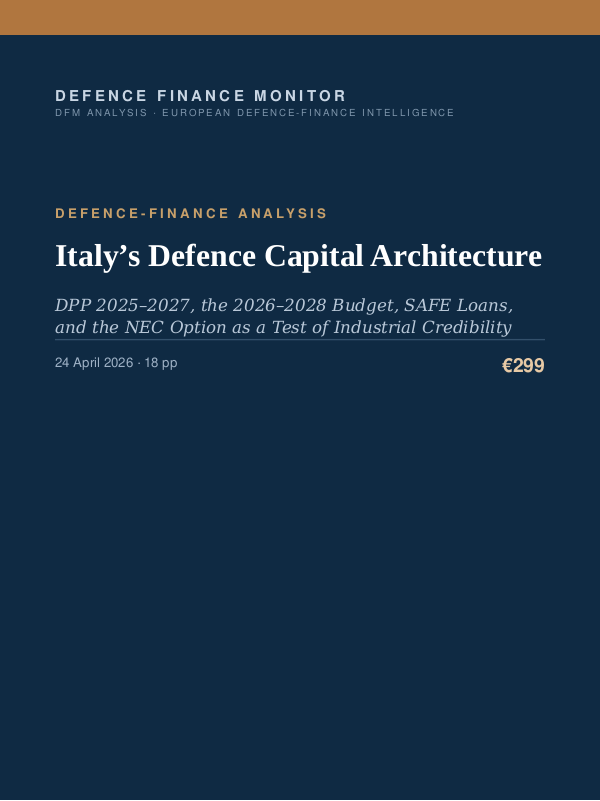 Full sourced report
Italy’s Defence Capital Architecture
View the report →
Full sourced report
Italy’s Defence Capital Architecture
View the report →
Keep getting the analysis
DFM publishes new defence-finance analysis every week.
Original DFM analysis
Italy’s Defence Capital Architecture
The publication details above identify the source used for this public thread.
FAQ
What is Italy’s Defence Capital Architecture?
It begins by reconstructing the official institutional baseline and distinguishing the ordinary defence budget, the integrated defence budget, and the broader NATO-relevant spending reconstruction.
Why is Italy’s Defence Capital Architecture strategically relevant to European defence?
The final sections assess whether this evolving framework is generating real procurement visibility for industry, how it compares with more fiscally protected European models…
Related DFM Platform threads
Explore this category Company Relevance
Professional requests (internal interest signal — not a marketplace; nothing is charged or promised)
See Professional & Institutional Access — plans, group/institutional seats and contact →
Defence Finance Monitor is an analytical and informational product. It does not constitute investment advice, financial advice or a recommendation to buy or sell securities. Subscriptions run on DFM Analysis. Payments for Professional Packs are processed securely by Stripe at checkout.