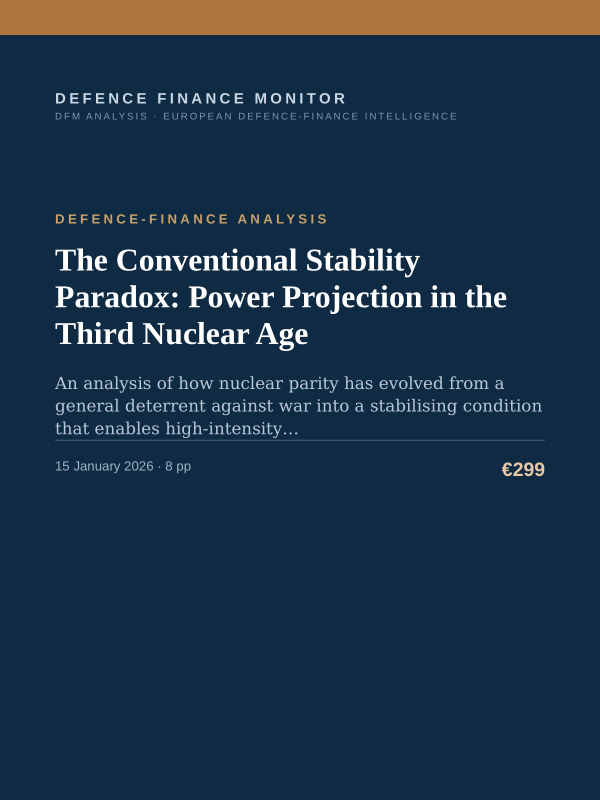
The Conventional Stability Paradox: Power Projection in the Third Nuclear Age
An analysis of how nuclear parity has evolved from a general deterrent against war into a stabilising condition that enables high-intensity conventional conflict, through the mechanisms of Instrumenta
What this report establishes
“The Conventional Stability Paradox: Power Projection in the Third Nuclear Age” is a sourced, structured Defence Finance Monitor analysis, closed on 15 January 2026. It establishes what is at stake, who the actors are and what it means for European defence funding and industry — drawn only from primary and official sources. This page summarises what the 8-page report determines; the figures, the evidence and the conclusions are in the report itself.
Who it's for
Strategy, corporate-development and investment teams that need an ecosystem-level view — budgets, industrial capacity and technology landscapes — before committing capital or capacity.
Key questions this report answers
- What is the conventional stability paradox, and how do nuclear weapons now encapsulate rather than merely prevent conflict?
- How do revisionist powers use their atomic arsenals as a protective shield to conduct high-intensity regional conventional operations?
- Why is the Third Nuclear Age's multipolar competition less predictable than the bilateral deterrence of the Cold War?
- What implications does the paradox hold for Western power-projection and force-structure investment?
Sample page
One full page from the report, exactly as delivered (8 pages in total).

Sources
This report is built only from primary and official sources — procurement notices, official documents, filings and company disclosures — cited in the document as of 15 January 2026. The source material itself is in the report, not on this page.
€299 excl. VAT — EU VAT calculated at checkout (VAT ID accepted for reverse charge); invoice issued after payment
≈ $348 — charged in euros; indicative equivalent at today's ECB reference rate.
Report — 8 pages · PDF · Analysis as of 15 January 2026 · Licensed single-user copy, watermarked to the buyer
A contents-paged report: a company's structure, portfolio, programme participation and funding record — or a market question measured with a stated method and full bibliography (Eurostat, TED, EU programme data). Use it to check a counterparty or a claim before committing time or budget.
This report €299 · All reports, the Funding Navigator and continuous updates — Annual Professional, €1,500/year excl. VAT →
One click to Stripe — guest checkout, no account. Your download appears on the confirmation page and arrives by e-mail right after payment (link valid 72 hours, up to 5 downloads).
Sold by STRONCATURE S.R.L. (VAT IT05960160652) · Secure checkout by Stripe · Instant watermarked PDF · EU invoice issued after payment.
Prepared by the DFM research desk — editor: Nunzio Mastrolia. Defence Finance Monitor is the defence-finance analysis publication of STRONCATURE S.R.L., Rome.
The analysis is public. The report is the document of record.
The analysis behind this report is published openly on DFM — that is how we work, and it does not change what you are buying. What you buy is the professional edition of that analysis: a dated, complete document with every source cited, structured for desk use, licensed to you, and citable in your own work. The free page is where the analysis lives; the report is what you file, rely on and cite.
Related reports
Methodology, format & delivery
DFM reports are built from primary and official sources — TED procurement notices, CORDIS and the EU Funding & Tenders Portal, EIB operations, the NATO Innovation Fund portfolio, SIPRI data, official budget documents and company disclosures — read together with the underlying legal texts. Sources are cited in the document; it reflects them as of its publication date (15 January 2026). You receive a 8-page report (PDF), watermarked to you on every page, delivered on the confirmation page and by e-mail immediately after checkout (personal link valid 72 hours, up to 5 downloads). Guest checkout, single-user licence — Terms of Sale.
Related on DFM
Read the free public analysis behind this report · More Strategic reports · All reports
For your role
Investors
Investment intelligence on this company or segment
Request an investment-intelligence brief →SMEs & scale-ups
Position your capability with European programmes
Request a positioning & funding-eligibility check →Universities & research
Technology scouting and multi-seat access for your group
Request technology scouting / team access →Legal & compliance
Eligibility, export-control and regulatory analysis
Request a compliance analysis →Institutional & team access. Labs, primes and universities can equip a whole desk — multi-seat / institutional licensing. Request team / institutional access →
Prefer unlimited access?
Prefer unlimited access? Every report like this is included in the DFM Analysis subscription. See plans →