Capability
The “Naval Combat Cloud”: Tactical Synchronization Digital Ship 2025
The Naval Combat Cloud Tactical Synchronization: what capability does it address, and how mature is it?
The digitalization of European naval forces has transitioned from a supporting function to a primary operational requirement for maintaining a competitive battle rhythm in contested environments.
This public thread presents the concise analytical answer. The complete evidence, source base and assessment are available below.
Part of our Defence & Dual-Use Companies and Policy, Procurement & Institutions coverage →
Platform publication · DFM Analysis report · 2026-06-26
The digitalization of European naval forces has transitioned from a supporting function to a primary operational requirement for maintaining a competitive battle rhythm in contested environments. Central to this transition is the European Defence Fund’s EDF-2025-DA-NAVAL-DSNCC-STEP call, which allocates €54 million to the development of a sovereign “Naval Combat Cloud”. This initiative aims to replace fragmented legacy communication systems with a federated architecture capable of real-time data exchange across diverse naval assets. By integrating ship operation systems ($SOTS$) into a common digital framework, the EU seeks to create a “Digital Ship” model that functions as a networked node within a broader multi-domain architecture.
This report analyzes the technical specifications for distributed sensor fusion and the implementation of artificial intelligence for automated decision support. Furthermore, it identifies strategic opportunities for Tier-2 suppliers specializing in ruggedized network hardware and secure software solutions. The analysis distinguishes established budgetary facts from long-term industrial scenarios, providing a neutral assessment of the program’s trajectory through 2030. Achieving strategic autonomy in the maritime domain is treated here as a direct result of capital allocation toward digital resilience.
The following paragraphs delineate the technical hurdles and industrial shifts required to field this interconnected combat capability. The €54 million investment focuses on designing, prototyping, and testing a multidomain naval combat cloud that federates services across surface, sub-surface, and air assets. Current maritime operations are often hindered by bandwidth limitations and the lack of a common digital infrastructure, which creates latency in critical targeting loops. The DSNCC project addresses these gaps by optimizing communication protocols and establishing standardized digital interfaces for $SOTS$ integration.
This architecture is designed to remain operational even during severe electronic warfare or the loss of primary command nodes.
Choose how to continue
Go deeper on this question
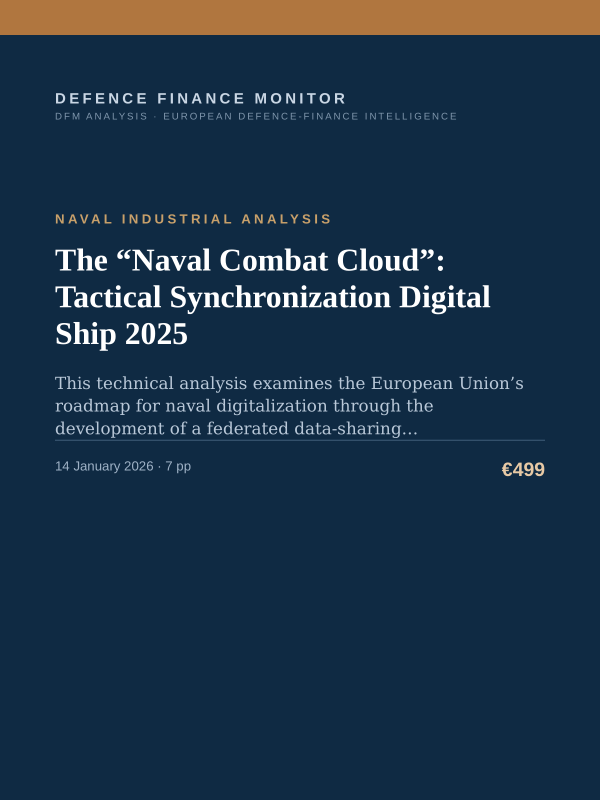 Full sourced report
The “Naval Combat Cloud”: Tactical Synchronization Digital Ship 2025
View the report →
Full sourced report
The “Naval Combat Cloud”: Tactical Synchronization Digital Ship 2025
View the report →
Keep getting the analysis
DFM publishes new analysis on Sensors, C4ISR & Communications every week.
Original DFM analysis
The Naval Combat Cloud Tactical Synchronization
The publication details above identify the source used for this public thread.
Related DFM Platform threads
Explore this category Strategic Autonomy
Professional requests (internal interest signal — not a marketplace; nothing is charged or promised)
See Professional & Institutional Access — plans, group/institutional seats and contact →
Defence Finance Monitor is an analytical and informational product. It does not constitute investment advice, financial advice or a recommendation to buy or sell securities. Subscriptions run on DFM Analysis. Payments for Professional Packs are processed securely by Stripe at checkout.