Capability
The Consolidation Of European Defence
The Consolidation of European Defence: what capability does it address, and how mature is it?
Europe’s defence-industrial base is entering a phase in which consolidation is no longer defined only by mergers between large contractors. It is increasingly driven by the acquisition of production capacity, control…
This public thread presents the concise analytical answer. The complete evidence, source base and assessment are available below.
Part of our Policy, Procurement & Institutions and Defence & Dual-Use Companies coverage →
Original DFM publication · DFM Analysis report · 2026-03-11
Europe’s defence-industrial base is entering a phase in which consolidation is no longer defined only by mergers between large contractors. It is increasingly driven by the acquisition of production capacity, control of critical subsystems, vertical integration in land and naval platforms, and the ability of prime contractors to shape programme governance. Rheinmetall, KNDS, Leonardo and TKMS now sit at the centre of a contest over scale, supply-chain leverage, platform ownership and future procurement standards.
The same logic extends into combat-air governance, where GCAP appears to be advancing through a clearer institutional and industrial structure while FCAS remains constrained by unresolved tensions over design authority, workshare and intellectual property. The report is structured in four sections. The first frames defence consolidation through regulation, capital markets and public procurement rules.
The second analyses Rheinmetall, KNDS and Leonardo as three distinct models of land-systems consolidation. The third maps the platform competition across land, naval and space-enabled ISR, with a focus on procurement awards, production capacity and industrial control. The fourth compares GCAP and FCAS as governance cases, assessing why programme authority, ownership structures and industrial leadership now carry direct financial and strategic consequences for European defence primes.
European defence consolidation is no longer an abstract policy ambition. It is taking place through a combination of capital-market repricing, targeted acquisitions, state-backed governance interventions, and programme-level industrial choices that increasingly reward scale, speed of execution, and clear design authority. Bain’s 2026 defence M&A assessment describes a sector in which European primes are scaling fast, cross-border partnerships are multiplying, and listed equity strength is becoming acquisition currency; McKinsey’s 2026 work points to a further structural point, namely that consolidation below the prime level could unlock about €9 billion of annual run-rate synergies in only four fragmented supply-chain segments.
Key takeaways
- The second analyses Rheinmetall, KNDS and Leonardo as three distinct models of land-systems consolidation.
- European defence consolidation is no longer an abstract policy ambition.
- The report is structured in four sections.
Choose how to continue
Go deeper on this question
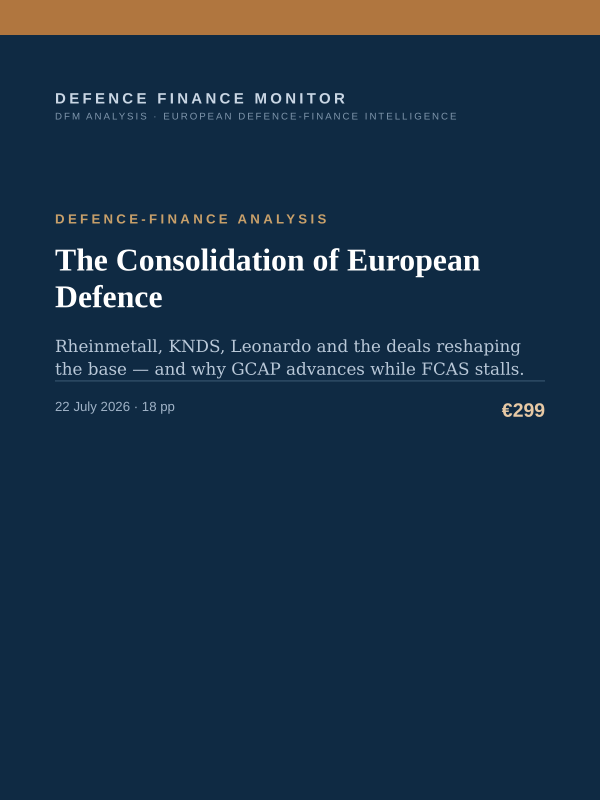 Full sourced report
The Consolidation of European Defence
View the report →
Full sourced report
The Consolidation of European Defence
View the report →
Keep getting the analysis
DFM publishes new analysis on Platforms, Propulsion & Power every week.
Original DFM analysis
The Consolidation Of European Defence
The publication details above identify the source used for this public thread.
FAQ
What is The Consolidation Of European Defence?
The same logic extends into combat-air governance, where GCAP appears to be advancing through a clearer institutional and industrial structure while FCAS remains constrained by unresolved tensions over design authority…
Why does The Consolidation Of European Defence matter for European defence?
The first frames defence consolidation through regulation, capital markets and public procurement rules.
Related DFM Platform threads
Explore this category Strategic Autonomy
Professional requests (internal interest signal — not a marketplace; nothing is charged or promised)
See Professional & Institutional Access — plans, group/institutional seats and contact →
Defence Finance Monitor is an analytical and informational product. It does not constitute investment advice, financial advice or a recommendation to buy or sell securities. Subscriptions run on DFM Analysis. Payments for Professional Packs are processed securely by Stripe at checkout.