Capability
The 20272029 Financing Transition
The 20272029 Financing Transition: what does it mean for European defence funding and who can access it?
Europe’s defence-finance landscape is entering a structurally sensitive phase. The issue is not the disappearance of public resources, but the growing misalignment between the duration and activation logic…
This public thread presents the concise analytical answer. The complete evidence, source base and assessment are available below.
Part of our Policy, Procurement & Institutions and Defence & Dual-Use Companies coverage →
Original DFM publication · DFM Analysis report · 2025-05-27
Europe’s defence-finance landscape is entering a structurally sensitive phase. The issue is not the disappearance of public resources, but the growing misalignment between the duration and activation logic of the instruments currently in force and the still-proposed status of the post-2027 framework. SAFE, EDIP, and the initial EIF Defence Equity Facility have been deployed rapidly to accelerate procurement, reinforce industrial capacity, and mobilise private capital. Yet these instruments are either temporally compressed, limited in scale, or already substantially allocated, while the 2028–2034 architecture remains in the legislative process.
For industrial actors operating on long investment cycles, the problem is therefore not absolute funding availability, but the adequacy of visibility and continuity over the time horizon required to commit capital and restructure supply chains. This report addresses that problem by maintaining a strict analytical separation between four distinct levels. It first establishes the legal and temporal status of the instruments currently in force, then examines their practical operational condition, including remaining activation capacity and real headroom. It proceeds to assess the existence and limits of bridge mechanisms available before the next MFF becomes fully operational, with particular attention to InvestEU-related guarantees and associated instruments.
Finally, it evaluates the proposed 2028–2034 architecture, including the European Competitiveness Fund, strictly as a forward-looking framework not yet operational. On this basis, the report determines whether the transition period between the current cycle and the next creates a material risk for industrial planning, and whether that risk should be understood primarily in terms of reduced visibility, constrained timing, and insufficient scale rather than a literal funding gap. Europe has, in a short period, built a layered set of Union instruments intended to accelerate defence demand, support joint procurement, reinforce industrial capacity, and crowd in private capital.
Choose how to continue
Go deeper on this question
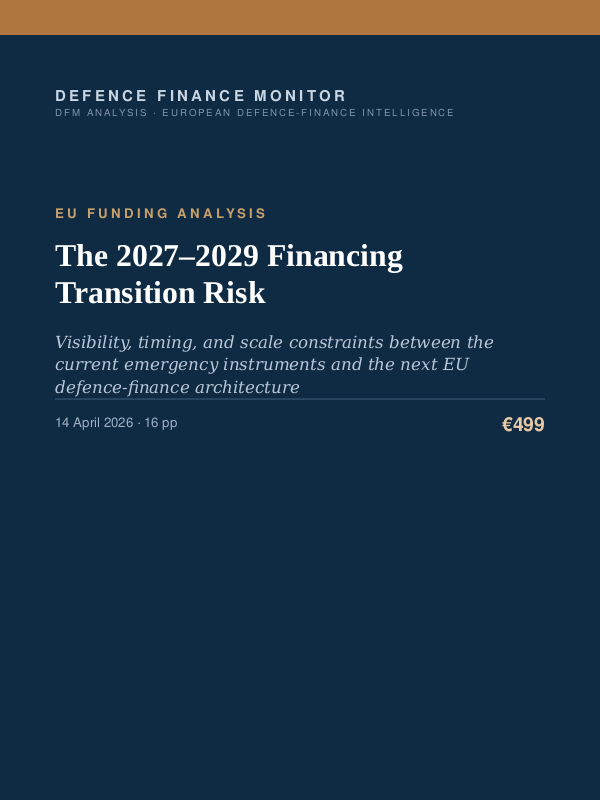 Full sourced report
The 2027–2029 Financing Transition Risk
View the report →
Full sourced report
The 2027–2029 Financing Transition Risk
View the report →
Keep getting the analysis
DFM publishes new defence-finance analysis every week.
Original DFM analysis
The 20272029 Financing Transition
The publication details above identify the source used for this public thread.
Related DFM Platform threads
Explore this category Strategic Autonomy
Professional requests (internal interest signal — not a marketplace; nothing is charged or promised)
See Professional & Institutional Access — plans, group/institutional seats and contact →
Defence Finance Monitor is an analytical and informational product. It does not constitute investment advice, financial advice or a recommendation to buy or sell securities. Subscriptions run on DFM Analysis. Payments for Professional Packs are processed securely by Stripe at checkout.