Capability
Security of Quantum Tactical Networks: The EDF 2026 Framework
Security of Quantum Tactical Networks: what capability does it address, and how mature is it?
The security of tactical communications is entering a transformative phase as European defense planners prepare for the emergence of cryptographically relevant quantum computers.
This public thread presents the concise analytical answer. The complete evidence, source base and assessment are available below.
Part of our Policy, Procurement & Institutions and Research, Universities & Deep Tech coverage →
Platform publication · DFM Analysis report · 2026-06-21
The security of tactical communications is entering a transformative phase as European defense planners prepare for the emergence of cryptographically relevant quantum computers. Central to this transition is the European Defence Fund’s EDF-2026-RA-CYBER-QSTN-STEP call, which provides a targeted investment of €14 million for Research Actions ($RA$) in quantum-secured tactical networking. This funding is specifically designed to catalyze the development of sovereign technologies that can protect military assets from adversarial “harvest now, decrypt later” strategies.
The initiative prioritizes the integration of Quantum Key Distribution ($QKD$) into highly mobile and constrained environments, such as forward-deployed units and tactical edge nodes. By isolating this budgetary fact, we can observe the European Union’s intent to move beyond theoretical quantum research toward tangible battlefield applications. This report analyzes the technical hurdles of miniaturization and the logistical requirements for deploying quantum terminals on dynamic platforms.
Furthermore, it maps the emerging startup ecosystem that provides Quantum-as-a-Service ($QaaS$) solutions tailored for the Euro-Atlantic security architecture. All evaluations are grounded in verifiable technical requirements, distinguishing confirmed research objectives from long-term industrial scenarios. The primary driver for this €14 million allocation is the vulnerability of current asymmetric encryption standards, such as RSA and Elliptic Curve Cryptography ($ECC$), to Shor’s algorithm.
In a tactical scenario, the interception of command-and-control ($C2$) data could lead to total mission failure if the adversary possesses the capability to break classical encryption in real-time or post-facto. Quantum Key Distribution ($QKD$) offers a solution by using the laws of physics, specifically the no-cloning theorem, to guarantee that any attempt to intercept a key is immediately detected. This ensures that the cryptographic keys used for securing tactical radios and data links remain untainted.
Choose how to continue
Go deeper on this question
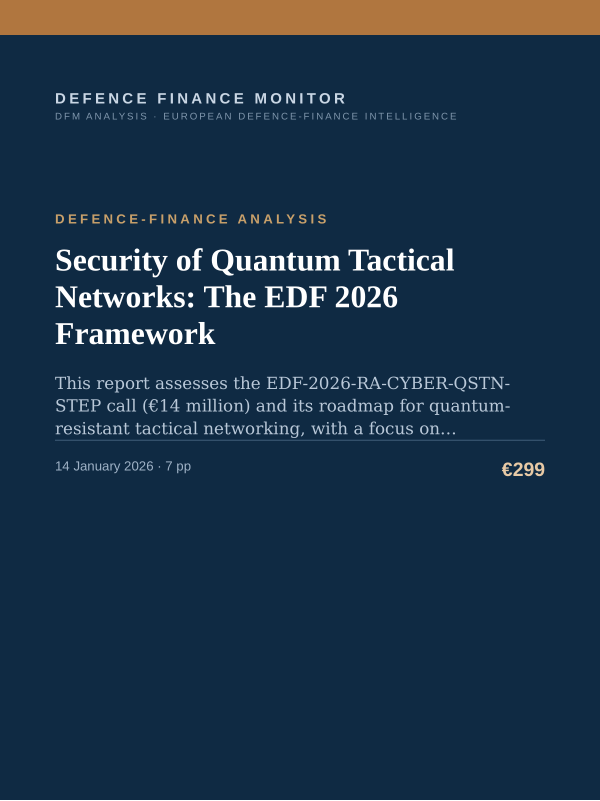 Full sourced report
Security of Quantum Tactical Networks: The EDF 2026 Framework
View the report →
Full sourced report
Security of Quantum Tactical Networks: The EDF 2026 Framework
View the report →
Keep getting the analysis
DFM publishes new analysis on Cyber & Electronic Warfare every week.
Original DFM analysis
Security Of Quantum Tactical Networks
The publication details above identify the source used for this public thread.
Related DFM Platform threads
Explore this category Strategic Autonomy
Professional requests (internal interest signal — not a marketplace; nothing is charged or promised)
See Professional & Institutional Access — plans, group/institutional seats and contact →
Defence Finance Monitor is an analytical and informational product. It does not constitute investment advice, financial advice or a recommendation to buy or sell securities. Subscriptions run on DFM Analysis. Payments for Professional Packs are processed securely by Stripe at checkout.