Capability
Nuclear Delivery Enablers and the Credibility of NATO Forward Defence Deterrence
What operational architecture do 'Nuclear Delivery Enablers' comprise beyond the weapons themselves?
Nuclear Delivery Enablers and the Credibility of NATO Forward Defence Deterrence: Nuclear deterrence within the North. Defence-finance analysis; 23-page source…
This public thread presents the concise analytical answer. The complete evidence, source base and assessment are available below.
Part of our Policy, Procurement & Institutions and Global Defence Institutions coverage →
Original DFM publication · DFM Analysis report · 2026-03-10
Nuclear deterrence within the North Atlantic Alliance is not sustained by the existence of nuclear weapons alone. Its credibility depends on the practical ability to generate, protect, command, and communicate the option of nuclear delivery under conditions of crisis and contested operations.
Nuclear Delivery Enablers represent the operational architecture that makes this credibility possible. They include dual-capable aircraft readiness, hardened infrastructure, survivable command-and-control, protected communications, secure logistics, and the governance processes that translate political decisions into operational capability.
This analysis answers: What operational architecture do 'Nuclear Delivery Enablers' comprise beyond the weapons themselves? What performance requirements and adequacy thresholds define credible nuclear delivery under crisis and contested operations? What system architecture integrates dual-capable aircraft readiness, hardened infrastructure and survivable command-and-control? What industrial base and sustainment bottlenecks affect the credibility of NATO forward-defence deterrence?
Choose how to continue
Go deeper on this question
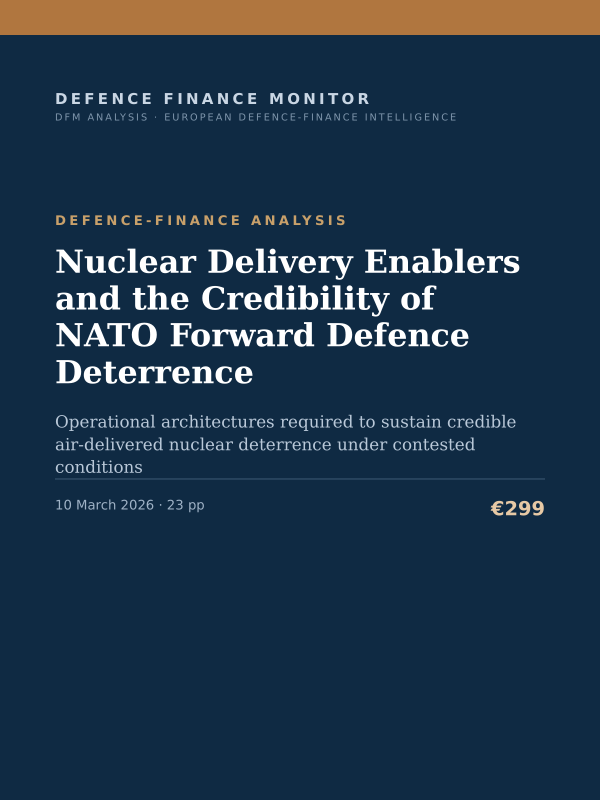 Full sourced report
Nuclear Delivery Enablers and the Credibility of NATO Forward Defence Deterrence
View the report →
Full sourced report
Nuclear Delivery Enablers and the Credibility of NATO Forward Defence Deterrence
View the report →
Keep getting the analysis
DFM publishes new analysis on Platforms, Propulsion & Power every week.
Original DFM analysis
Nuclear Delivery Enablers and the Credibility of NATO Forward Defence Deterrence
The publication details above identify the source used for this public thread.
Related DFM Platform threads
- Europe's High-Low Arsenal: $50.66bn Pledged to Deep Strike, and the Magazine No Public Record Sets
- UK's £400k Strike Weapon vs the $4m PAC-3 MSE: Why Cheap Autonomy Forces Europe to Buy More Layers, Not Fewer
- PAC-3, SAMP/T and Europe's Missile Constraint: Can Cheap Unmanned Mass Substitute for the Expensive Upper Layer?
Explore this category Strategic Autonomy
Professional requests (internal interest signal — not a marketplace; nothing is charged or promised)
See Professional & Institutional Access — plans, group/institutional seats and contact →
Defence Finance Monitor is an analytical and informational product. It does not constitute investment advice, financial advice or a recommendation to buy or sell securities. Subscriptions run on DFM Analysis. Payments for Professional Packs are processed securely by Stripe at checkout.