Capability
Naval Supremacy and Underwater Resilience: Strategic Integration in the 2026 EDF
Naval Supremacy and Underwater Resilience: what does it mean for European defence funding and who can access it?
The formal adoption of the 2026 Work Programme for the European Defence Fund on 17 December 2025 has established the maritime and underwater domains as critical frontiers for the Union’s strategic autonomy.
This public thread presents the concise analytical answer. The complete evidence, source base and assessment are available below.
Part of our Policy, Procurement & Institutions and Defence & Dual-Use Companies coverage →
Platform publication · DFM Analysis report · 2026-06-25
The formal adoption of the 2026 Work Programme for the European Defence Fund on 17 December 2025 has established the maritime and underwater domains as critical frontiers for the Union’s strategic autonomy. This sixth annual cycle represents a fundamental shift toward the integration of semi-autonomous naval systems and the protection of critical subsea assets. By orchestrating a coordinated portfolio of research and development initiatives, the Commission is addressing the urgent need to secure European littoral waters and deep-sea infrastructure.
The maritime domain is no longer viewed solely as a theater for traditional naval power but as a complex ecosystem where digital connectivity and physical protection must converge. This report focuses on the strategic allocation of 130 millions to the NAVAL and UWW categories, exploring how these funds will drive the next generation of maritime capabilities. The 2026 cycle serves as a definitive signal to the European defense industry that long-term institutional demand is moving toward modular and autonomous solutions.
Consequently, the industrial landscape is being reshaped to support a unified European maritime defense architecture. This introductory phase underscores the collective commitment of the Member States to achieving a resilient and technologically sovereign maritime presence by 2030. Achieving these goals requires deep integration between established naval primes and the emerging sector of marine robotics.
The following analysis details the financial breakdown and the specific technical requirements for the 2026 maritime projects. The financial architecture for the naval and underwater sectors in 2026 is defined by a concentrated investment of 130 millions, which is strategically divided between surface combat and subsea warfare. The NAVAL category receives 90 millions, while the Underwater Warfare category is allocated 40 millions, reflecting the increasing priority of securing the continent’s maritime frontiers and critical seabed assets.
Key takeaways
- Consequently, the industrial landscape is being reshaped to support a unified European maritime defense architecture.
- The following analysis details the financial breakdown and the specific technical requirements for the 2026 maritime projects.
- The 2026 cycle serves as a definitive signal to the European defense industry that long-term institutional demand is moving toward modular and autonomous solutions.
Choose how to continue
Go deeper on this question
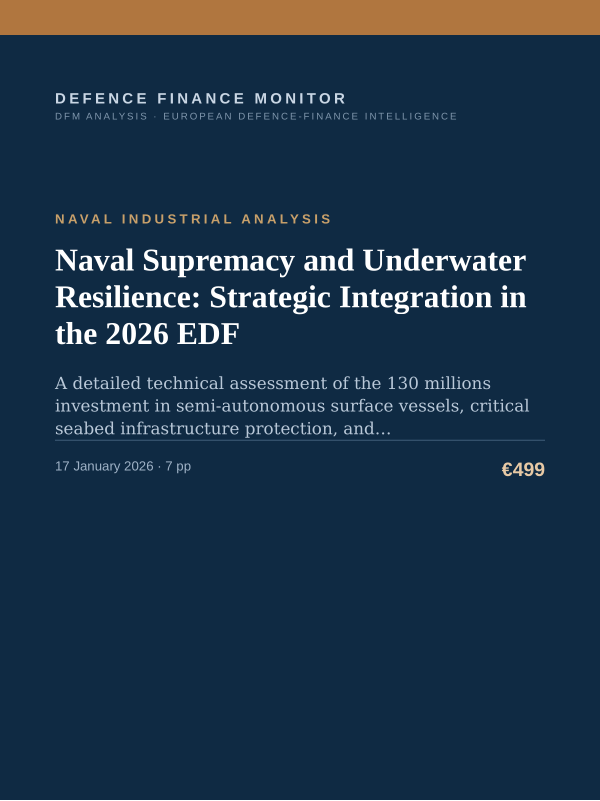 Full sourced report
Naval Supremacy and Underwater Resilience: Strategic Integration in the 2026 EDF
View the report →
Full sourced report
Naval Supremacy and Underwater Resilience: Strategic Integration in the 2026 EDF
View the report →
Keep getting the analysis
DFM publishes new analysis on Autonomy, Robotics & AI every week.
Original DFM analysis
Naval Supremacy And Underwater Resilience
The publication details above identify the source used for this public thread.
FAQ
What is Naval Supremacy and Underwater Resilience: Strategic Integration in the 2026 EDF?
The maritime domain is no longer viewed solely as a theater for traditional naval power but as a complex ecosystem where digital connectivity and physical protection must converge.
Why does Naval Supremacy and Underwater Resilience: Strategic Integration in the 2026 EDF matter for European defence?
This report focuses on the strategic allocation of 130 millions to the NAVAL and UWW categories, exploring how these funds will drive the next generation of maritime capabilities.
Related DFM Platform threads
Explore this category Strategic Autonomy
Professional requests (internal interest signal — not a marketplace; nothing is charged or promised)
See Professional & Institutional Access — plans, group/institutional seats and contact →
Defence Finance Monitor is an analytical and informational product. It does not constitute investment advice, financial advice or a recommendation to buy or sell securities. Subscriptions run on DFM Analysis. Payments for Professional Packs are processed securely by Stripe at checkout.