Capability
A $350m Army Ceiling Built on $310,577 of Research
which would prove the fiscal gate is not the binding one — or renovations and equipment sets that leave it firmly in place?
On 4 August 2026 the US Army handed BeaverFit North America a firm-fixed-price, single-award, indefinite-delivery contract with a $350,000,000 ceiling a…
This public thread presents the concise analytical answer. The complete evidence, source base and assessment are available below.
Part of our Defence & Dual-Use Companies and Policy, Procurement & Institutions coverage →
Original DFM publication · DFM Analysis report · 2026-08-12
Analysis as of 12 August 2026.
On 4 August 2026 the US Army handed BeaverFit North America a firm-fixed-price, single-award, indefinite-delivery contract with a $350,000,000 ceiling and an ordering period stretching to 4 August 2033. The announcement records that one bid was solicited over the internet and one was received. For context: the company's entire recorded federal research funding amounts to $310,577 across three small Phase I awards, and the ceiling is roughly 275 times the $1.272 million the Army spread across seven competing firms in the 2023 research round that started this lineage. A ceiling of this kind is a legal capacity to order, not a purchase — and the distance between the two is where the whole story sits.
The lineage that would justify the exclusivity is only partly on the record. Army topic A234-005, released in December 2022, framed existing readiness-centre construction as too expensive and drew seven distinct Phase I concepts — modular steel, air-supported membranes, composites, prefabricated net-zero designs. BeaverFit's slice was $160,687. The company states it went on to hold a Phase II award; the federal database still records zero Phase II dollars against its name. No public document designates the 2026 vehicle as an SBIR Phase III, discloses the minimum guarantee that separates a binding contract from an option, or explains the authority under which a single award above the $150 million threshold was justified. The procurement file that would answer all of this exists — inside the Army, not in public.
Even if the contractual gate were fully explained, a second gate operates order by order. The scope mixes equipment with structures, and those categories obey different money. Under the military-construction statute, a complete and usable facility is measured as a whole — foundations, utilities and supporting work included — with a $9 million ceiling for unspecified minor projects and operation-and-maintenance funds usable only up to $4 million. A demountable fabric building does not escape classification just because its superstructure unbolts. The vehicle compresses source selection to zero; it does nothing to compress installation programming, environmental review, site approval or appropriation availability.
The demand behind the ceiling is real but shapeless. The Army plans 129 active brigades fielded with performance teams by fiscal 2029, plus 59 area support teams; its announced 2026 facility activity was 67 improvements and four experimental new-construction designs. But brigade counts do not convert into buildings — at Fort Jackson a single renovated 40,000-square-foot centre serves two brigades — and the cost references in the record differ by a factor of nearly three: the contractor's own 2023 target of $6 million per facility against a $16 million-plus figure another bidder cited for conventional construction. One yardstick implies the ceiling covers dozens of sites; the other, barely twenty-two. Behind the contract stands a firm the SBA lists at 78 employees, freshly merged across the Atlantic in June 2024, whose UK filings state that no registrable controlling person exists.
Three tests, none of which the public record can currently pass, will reveal what this ceiling actually is:
— Will the first orders issued under the vehicle turn out to be complete new structures at multiple installations, funded from military-construction appropriations within the first year — which would prove the fiscal gate is not the binding one — or renovations and equipment sets that leave it firmly in place?
— Will a Phase III determination and a technical mapping ever surface, tracing the ordered work to identified outputs of the 2023 research and the claimed Phase II — or will a single solicited bid remain the only explanation on file for why one supplier holds the whole scope?
— When the minimum guarantee finally becomes visible, will it disclose an enforceable purchasing floor of real size — or an option dressed in the clothes of a $350 million programme?
Key takeaways
- The lineage that would justify the exclusivity is only partly on the record.
- Even if the contractual gate were fully explained, a second gate operates order by order.
- The demand behind the ceiling is real but shapeless.
Choose how to continue
Go deeper on this question
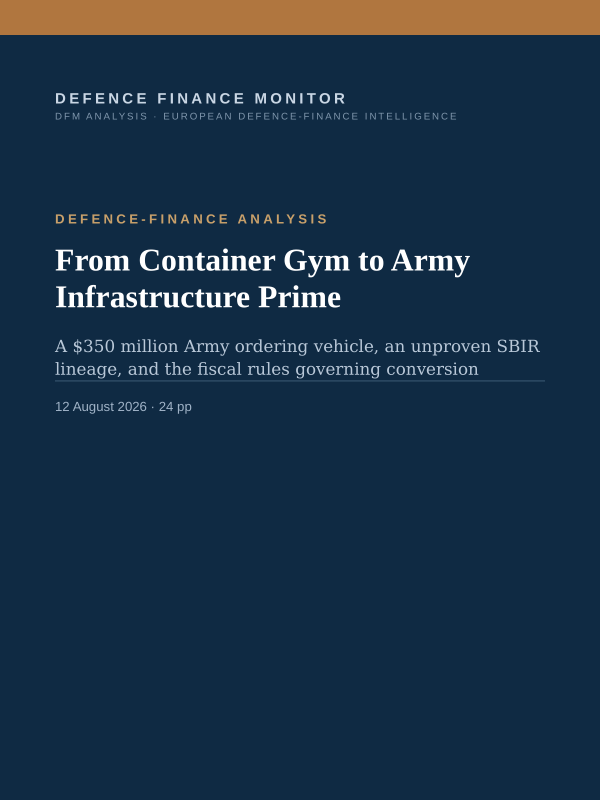 Full sourced report
From Container Gym to Army Infrastructure Prime
View the report →
Full sourced report
From Container Gym to Army Infrastructure Prime
View the report →
Keep getting the analysis
DFM publishes new defence-finance analysis every week.
Original DFM analysis
From Container Gym to Army Infrastructure Prime
The publication details above identify the source used for this public thread.
FAQ
What is A $350m Army Ceiling Built on $310,577 of Research?
On 4 August 2026 the US Army handed BeaverFit North America a firm-fixed-price, single-award, indefinite-delivery contract with a $350,000,000 ceiling and an ordering period stretching to 4 August 2033.
Why does A $350m Army Ceiling Built on $310,577 of Research matter for European defence?
A demountable fabric building does not escape classification just because its superstructure unbolts.
Related DFM Platform threads
- Europe's High-Low Arsenal: $50.66bn Pledged to Deep Strike, and the Magazine No Public Record Sets
- UK's £400k Strike Weapon vs the $4m PAC-3 MSE: Why Cheap Autonomy Forces Europe to Buy More Layers, Not Fewer
- PAC-3, SAMP/T and Europe's Missile Constraint: Can Cheap Unmanned Mass Substitute for the Expensive Upper Layer?
Explore this category Strategic Autonomy
Professional requests (internal interest signal — not a marketplace; nothing is charged or promised)
See Professional & Institutional Access — plans, group/institutional seats and contact →
Defence Finance Monitor is an analytical and informational product. It does not constitute investment advice, financial advice or a recommendation to buy or sell securities. Subscriptions run on DFM Analysis. Payments for Professional Packs are processed securely by Stripe at checkout.