Capability
Seven Missions, Three Names: Where Europe's Small-Launch Bet Stands
Will any private entrant convert a framework position into an insured, licensed orbital delivery before the 2028 horizon closes, and if so, will it be one firm or the two that would signal a genuine market rather than a single survivor?
When ESA threw the Flight Ticket Initiative open to new bidders on 25 June 2026, the most revealing detail was not the 17 July deadline but the entry co…
This public thread presents the concise analytical answer. The complete evidence, source base and assessment are available below.
Part of our Defence & Dual-Use Companies and Policy, Procurement & Institutions coverage →
Original DFM publication · DFM Analysis report · 2026-08-06
Analysis as of 6 August 2026.
When ESA threw the Flight Ticket Initiative open to new bidders on 25 June 2026, the most revealing detail was not the 17 July deadline but the entry condition. Newcomers were welcome only if they expected to be flying before 2028. That single clause converts a subsidy scheme into a sorting device. Europe has no shortage of funded launcher ventures; what its institutions were asking, in effect, was which of them could be treated as a counterparty rather than a project. The reopening also came with an admission built in: the fifth batch of six demonstration missions was ready to fly, and the existing pool of providers was judged too narrow to absorb them.
The arithmetic behind that judgement is stark. Member states pledged more than €4.4 billion to space-transportation programmes at the November 2025 Ministerial Council, yet the Initiative had allocated only seven missions by mid-July 2026, and those seven sat with just three companies — Avio, Isar Aerospace and Rocket Factory Augsburg. More telling still is the ladder the mechanism exposes. Holding a framework contract, winning a work order and actually delivering a payload to orbit are separate conditions, and as of 18 July 2026 no private firm inside the scheme had reached the last of them. Europe's baseline autonomy is not in doubt — Ariane 6 and Vega-C carry it — but the market layer beneath those two vehicles remains, for a paying institutional customer, a promise rather than an option.
Even the eligibility layer is unstable. Across the official record, four different rosters of approved providers coexist, and no two match. Some of the churn is traceable: Avio took over the Vega service role from Arianespace in July 2025, and Orbex's operating company entered administration in February 2026 — this despite £20 million of UK government backing announced only a year earlier. But the residual confusion is itself a finding. If a procurement official cannot establish from any single institutional page who is currently entitled to bid, the sector has not yet reached the administrative maturity its political sponsors describe.
Capital, meanwhile, has run ahead of flight. Isar closed a €270 million round in June 2026 and signed up a second launch site in Nova Scotia in July — yet its qualification vehicle stayed on the ground through four attempts across January, March, April and June, halted by a stray vessel, a pressure-vessel leak and unexplained fluid-system behaviour. PLD Space assembled €210 million during 2026, including venture debt from the EIB, without holding a single booked mission. Against that, the incumbent benchmark is unforgiving: Vega-C logged five flights in eighteen months after its return to service, and Ariane 6 flew three heavy missions in the first half of 2026 alone, lofting Amazon Leo batches of 32 and then 36 satellites. The gap between raised money and demonstrated cadence is the real subject of this test, and by August 2026 it had not narrowed.
What remains open is precisely what the next eighteen months must settle. Will any private entrant convert a framework position into an insured, licensed orbital delivery before the 2028 horizon closes, and if so, will it be one firm or the two that would signal a genuine market rather than a single survivor? Can Isar turn its repeated scrubs into a qualification flight fast enough to keep its booked missions commercially meaningful, or does the initiative's centre of gravity drift further toward Vega-C by default? Does PLD's heavy spending at Kourou eventually buy it the work order that has so far eluded it, or does capital without allocation prove a dead end? And when the fifth batch is awarded, will the winners come from the four incumbents, or will a name absent from every current list — as MaiaSpace is absent today — force the rosters to be rewritten yet again before anyone has flown?
Key takeaways
- The arithmetic behind that judgement is stark.
- Even the eligibility layer is unstable.
- Capital, meanwhile, has run ahead of flight.
Choose how to continue
Go deeper on this question
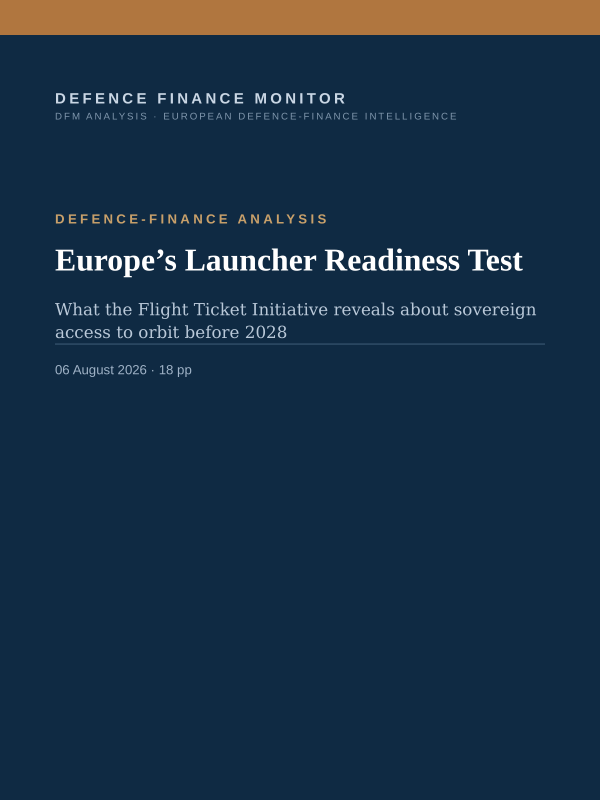 Full sourced report
Europe’s Launcher Readiness Test
View the report →
Full sourced report
Europe’s Launcher Readiness Test
View the report →
Keep getting the analysis
DFM publishes new analysis on Space, Satellites & PNT every week.
Original DFM analysis
Europe’s Launcher Readiness Test
The publication details above identify the source used for this public thread.
FAQ
What is Seven Missions, Three Names: Where Europe's Small-Launch Bet Stands?
When ESA threw the Flight Ticket Initiative open to new bidders on 25 June 2026, the most revealing detail was not the 17 July deadline but the entry condition.
Why does Seven Missions, Three Names: Where Europe's Small-Launch Bet Stands matter for European defence?
Europe has no shortage of funded launcher ventures; what its institutions were asking, in effect, was which of them could be treated as a counterparty rather than a project.
Related DFM Platform threads
- Europe's High-Low Arsenal: $50.66bn Pledged to Deep Strike, and the Magazine No Public Record Sets
- UK's £400k Strike Weapon vs the $4m PAC-3 MSE: Why Cheap Autonomy Forces Europe to Buy More Layers, Not Fewer
- PAC-3, SAMP/T and Europe's Missile Constraint: Can Cheap Unmanned Mass Substitute for the Expensive Upper Layer?
Explore this category Strategic Autonomy
Professional requests (internal interest signal — not a marketplace; nothing is charged or promised)
See Professional & Institutional Access — plans, group/institutional seats and contact →
Defence Finance Monitor is an analytical and informational product. It does not constitute investment advice, financial advice or a recommendation to buy or sell securities. Subscriptions run on DFM Analysis. Payments for Professional Packs are processed securely by Stripe at checkout.