Capability
EDIP Work Programme 2026–2027: Financing Europe’s Defence Industrial Scale-Up
EDIP Work Programme 2026–2027: Financing Europe’s Defence Industrial Scale-Up: what does it mean for European defence funding and who can access it?
Europe’s defence-industrial problem is no longer only a question of capability planning. It is now a question of financing production capacity, securing supply chains, aggregating procurement demand and reducing…
This public thread presents the concise analytical answer. The complete evidence, source base and assessment are available below.
Part of our Policy, Procurement & Institutions and Defence & Dual-Use Companies coverage →
Original DFM publication · DFM Analysis report · 2026-07-21
Europe’s defence-industrial problem is no longer only a question of capability planning. It is now a question of financing production capacity, securing supply chains, aggregating procurement demand and reducing dependence on constrained or non-European inputs. The EDIP Work Programme 2026–2027 turns Regulation (EU) 2025/2643 into an operational funding architecture for common procurement, industrial reinforcement, Ukraine-linked defence production and European Defence Projects of Common Interest.
For Defence Finance Monitor readers, the central issue is how this architecture changes the financial logic of defence-industrial scale-up: grant-backed capital expenditure, order visibility, eligibility risk, supply-chain localisation, working-capital pressure and the bankability of production readiness. The report first examines EDIP’s legal and budgetary architecture, distinguishing the binding framework of Regulation (EU) 2025/2643 from the Commission’s 2026–2027 Work Programme. It then analyses the programme’s main financing instruments, including common procurement actions, industrial reinforcement actions, the Ukraine Support Instrument, FAST/DEF 2.0, SEAP and EDPCI-related support.
The third section translates those instruments into capability and supply-chain exposure across ammunition, missiles, drones, air and missile defence, C5ISR, critical electronics, space-related systems and production infrastructure. The final section assesses governance, eligibility, control, third-country dependencies, classified-information handling and implementation risk, before drawing out what EDIP means for defence corporates, investors, lenders, procurement authorities and sovereign stakeholders. The European Defence Industry Programme is the first EU instrument that tries to connect defence-industrial policy, collaborative procurement incentives, production-capacity reinforcement, Ukraine-linked industrial integration and capital-market mobilisation within a single operational framework.
Choose how to continue
Go deeper on this question
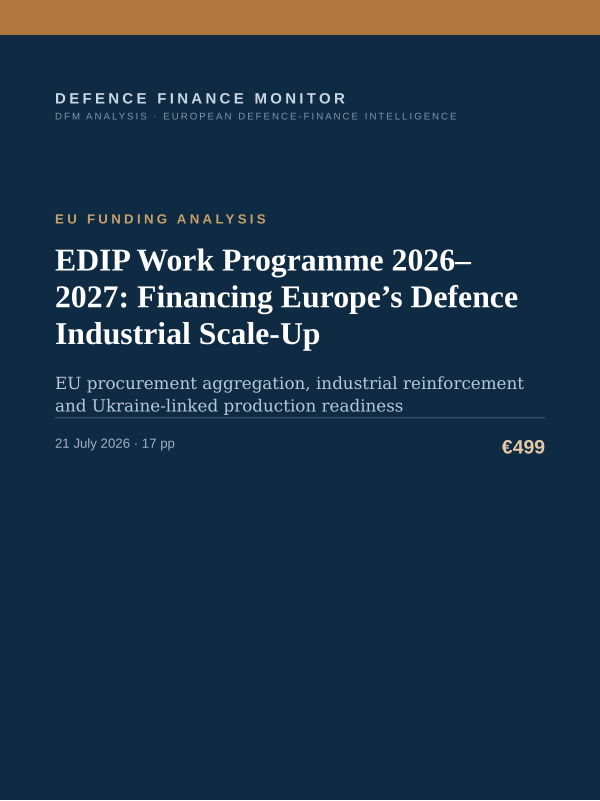 Full sourced report
EDIP Work Programme 2026–2027: Financing Europe’s Defence Industrial Scale-Up
View the report →
Full sourced report
EDIP Work Programme 2026–2027: Financing Europe’s Defence Industrial Scale-Up
View the report →
Keep getting the analysis
DFM publishes new analysis on Advanced Materials & Manufacturing every week.
Original DFM analysis
EDIP Work Programme 2026–2027: Financing Europe’s Defence Industrial Scale-Up
The publication details above identify the source used for this public thread.
Related DFM Platform threads
Explore this category Strategic Autonomy
Professional requests (internal interest signal — not a marketplace; nothing is charged or promised)
See Professional & Institutional Access — plans, group/institutional seats and contact →
Defence Finance Monitor is an analytical and informational product. It does not constitute investment advice, financial advice or a recommendation to buy or sell securities. Subscriptions run on DFM Analysis. Payments for Professional Packs are processed securely by Stripe at checkout.