Capability
Defense of Japan 2025 – Industrial Policy, Procurement, and Technology Integration
What does the Defense of Japan 2025 white paper reveal about industrial policy and procurement, and why does it matter for European defence?
Japan's Defense of Japan 2025 white paper signals an evolving industrial policy and procurement strategy — with lessons that matter for European defence too.
This public thread presents the concise analytical answer. The complete evidence, source base and assessment are available below.
Part of our Policy, Procurement & Institutions and Defence & Dual-Use Companies coverage →
Platform publication · DFM Analysis report · 2026-06-18
This report provides a detailed examination of the Defense of Japan 2025 white paper, with particular attention to the country's evolving defense industrial policy, procurement strategies, and the integration of emerging technologies into national defense planning.
A national white paper that foregrounds defence-industrial policy, procurement strategy and the integration of emerging technologies is a window into how a major industrial power intends to build capability. The relevance for Europe lies in the parallels: how procurement is structured, how emerging technologies are absorbed into planning, and how industrial capacity is mobilised. The capability question is less about any single system than about whether industrial policy can translate strategic intent into fielded, sustainable capability at the required pace. Industrial policy is often where ambition meets the hard limits of supply chains and skills, so the document's treatment of those constraints is as revealing as its stated priorities.
Industrially and from a market perspective, the document is useful as a guide to where priorities — and therefore demand — are likely to concentrate. Readers should examine the assumptions behind the stated procurement approach, how supply-chain and industrial-base considerations are weighted, and which lessons transfer to European programmes facing similar pressures. Comparing approaches across allied industrial powers helps separate durable direction from rhetoric, and identifies where European and partner priorities might align or compete in a constrained supplier base. The deeper question is whether stated intent is matched by the industrial capacity and skills to actually deliver it. The full DFM Analysis report sets out the complete source base, the supporting figures and the detailed assessment behind this view.
Choose how to continue
Go deeper on this question
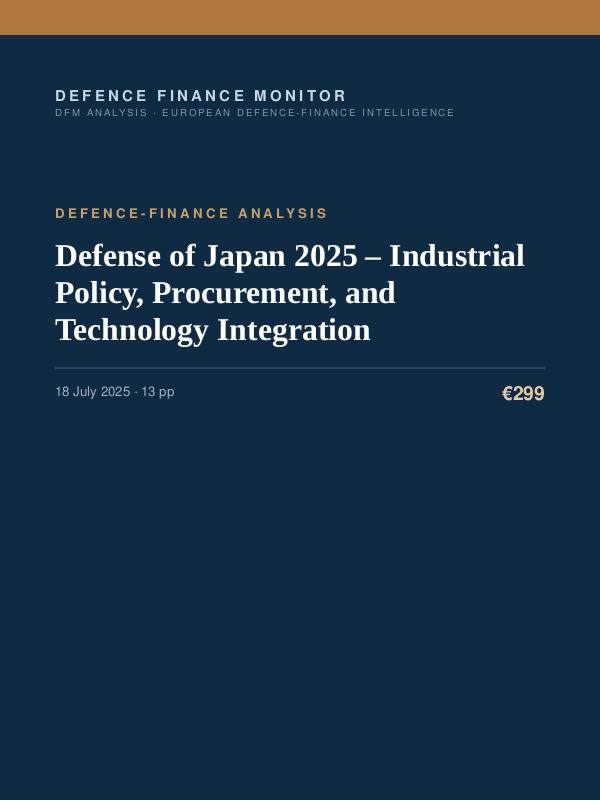 Full sourced report
Defense of Japan 2025 – Industrial Policy, Procurement, and Technology Integration
View the report →
Full sourced report
Defense of Japan 2025 – Industrial Policy, Procurement, and Technology Integration
View the report →
Keep getting the analysis
DFM publishes new defence-finance analysis every week.
Original DFM analysis
Defense Of Japan 2025 Industrial
The publication details above identify the source used for this public thread.
Related DFM Platform threads
Explore this category Strategic Autonomy
Professional requests (internal interest signal — not a marketplace; nothing is charged or promised)
See Professional & Institutional Access — plans, group/institutional seats and contact →
Defence Finance Monitor is an analytical and informational product. It does not constitute investment advice, financial advice or a recommendation to buy or sell securities. Subscriptions run on DFM Analysis. Payments for Professional Packs are processed securely by Stripe at checkout.