Capability
The $191.6 Million Army Wheel Deal That Guarantees Nothing
the data access, the economics, the qualified-source map — and could it change back just as quietly?
On 3 August 2026 the Defense Logistics Agency named Hutchinson Industries of Trenton, New Jersey, sole holder of a firm-fixed-price requirements contrac…
This public thread presents the concise analytical answer. The complete evidence, source base and assessment are available below.
Part of our Defence & Dual-Use Companies and Policy, Procurement & Institutions coverage →
Original DFM publication · DFM Analysis report · 2026-08-16
Analysis as of 16 August 2026.
On 3 August 2026 the Defense Logistics Agency named Hutchinson Industries of Trenton, New Jersey, sole holder of a firm-fixed-price requirements contract for a single military wheel-and-tyre assembly, with a stated maximum of $191,574,900 and an ordering window that closes on 2 August 2031. Fourteen bidders responded — a striking count for an item whose two previous competitions, in 2021 and 2023, each drew exactly one offer. For the next five years, routine government demand for this one national stock number flows to one prime through delivery orders, without further competition at each purchase.
The headline number deserves immediate deflation. Under American procurement law, the quantities in a requirements contract are estimates, not purchases; the government promises to route its actual needs through the holder, and owes nothing if those needs fail to materialise. The schedule anticipates 11,250 assemblies a year, which against the ceiling implies an average of about $3,406 per unit — while the agency's own catalogue lists the item at $5,538, a figure inflated by a cost-recovery surcharge that reaches 22.2 per cent in fiscal 2027. More telling still: the working-capital fund that pays for spares budgets just $49.2 million in fiscal 2027 for the entire heavy tactical truck family this wheel serves. A straight-line draw on the ceiling, roughly $38.3 million a year, would swallow nearly four-fifths of that whole line. The maximum is a legal boundary, not a forecast.
The more interesting question is what kind of concentration this creates. The top-level drawing carries a military entity code — the government, not the contractor, owns the item's identity. The component lines beneath it carry multiple commercial codes: two different codes on the wheel halves, three separate references on the tyre alone. What the government furnishes bidders are engineering design drawings, deliberately excluding process and shop-floor knowledge; the prime must build its own manufacturing methods and answer for cumulative tolerances. And qualification law binds approval to specific plants and sources — a change of factory or ownership forces re-evaluation before any award, at the candidate's own expense, with no obligation on the government to wait. A September 2025 audit of weapon-system data rights found that across more than two hundred sustainment programmes, half reported deficiencies in data or licence rights that blocked competitive procurement — the condition the department itself calls vendor lock.
Context sharpens the stakes. The truck family behind this assembly spent 15.4 per cent of fiscal 2025 not mission capable for lack of critical spares, against a 10 per cent ceiling the Army sets for ground systems. The prior prime, awarded a $156 million contract for these assemblies in 2023 on a single response, was a Wisconsin firm whose recorded place of performance was — curiously — New Jersey. The jump from one bidder to fourteen suggests the earlier isolation belonged to the requirement, not to any company. Meanwhile the signed price schedule, the single-award determination that a ceiling above $150 million requires, the data-rights assertions and the approved-source lists all remain outside the public record.
So the award leaves a knot of questions that only the unpublished file can untie, and they pull against one another: if fourteen firms could credibly bid in 2026 where one bid twice before, what actually changed — the data access, the economics, the qualified-source map — and could it change back just as quietly? When the government owns the drawing but the process knowledge lives in a contractor's work instructions, who really holds the item, and what would it cost the next competitor to find out? Does a five-year single channel discipline a fragile supply chain or quietly finish the narrowing it was meant to survive? How should anyone price a ceiling that is nearly four times the platform's entire annual spares budget? And if Congress does redraw the statutory line between maintenance data and manufacturing data, as auditors have formally proposed, will this concentration prove contractual and reversible at the 2031 recompetition — or industrial, and already settled?
Choose how to continue
Go deeper on this question
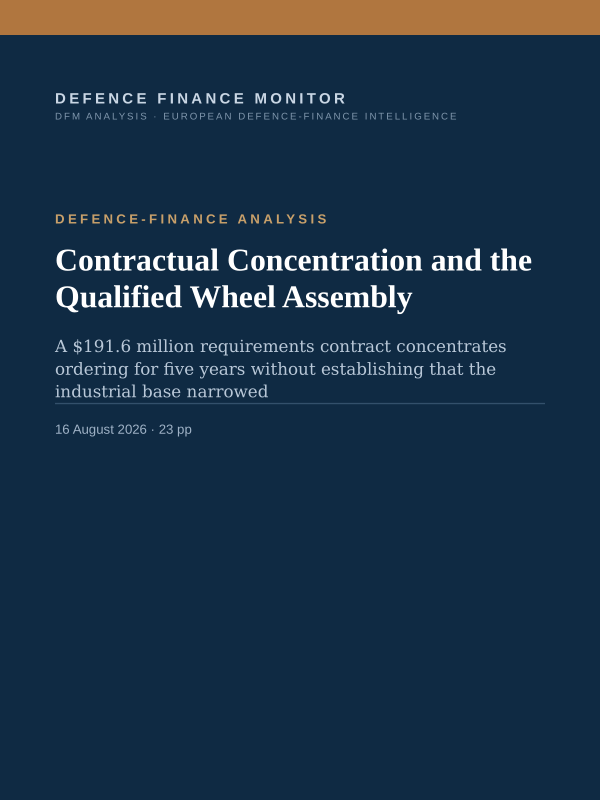 Full sourced report
Contractual Concentration and the Qualified Wheel Assembly
View the report →
Full sourced report
Contractual Concentration and the Qualified Wheel Assembly
View the report →
Keep getting the analysis
DFM publishes new defence-finance analysis every week.
Original DFM analysis
Contractual Concentration and the Qualified Wheel Assembly
The publication details above identify the source used for this public thread.
Related DFM Platform threads
- Europe's High-Low Arsenal: $50.66bn Pledged to Deep Strike, and the Magazine No Public Record Sets
- UK's £400k Strike Weapon vs the $4m PAC-3 MSE: Why Cheap Autonomy Forces Europe to Buy More Layers, Not Fewer
- PAC-3, SAMP/T and Europe's Missile Constraint: Can Cheap Unmanned Mass Substitute for the Expensive Upper Layer?
Explore this category Strategic Autonomy
Professional requests (internal interest signal — not a marketplace; nothing is charged or promised)
See Professional & Institutional Access — plans, group/institutional seats and contact →
Defence Finance Monitor is an analytical and informational product. It does not constitute investment advice, financial advice or a recommendation to buy or sell securities. Subscriptions run on DFM Analysis. Payments for Professional Packs are processed securely by Stripe at checkout.