Capability
Advanced Materials For European Defence
Advanced Materials for European Defence: what capability does it address, and how mature is it?
Europe’s defence-industrial readiness will not be determined only by budgets, prime contractors or major platform programmes. It will also depend on a less visible layer of qualified materials, processes and suppliers…
This public thread presents the concise analytical answer. The complete evidence, source base and assessment are available below.
Part of our Policy, Procurement & Institutions and Defence & Dual-Use Companies coverage →
Platform publication · DFM Analysis report · 2026-07-09
Europe’s defence-industrial readiness will not be determined only by budgets, prime contractors or major platform programmes. It will also depend on a less visible layer of qualified materials, processes and suppliers: aerospace-grade titanium, superalloys, carbon-fibre systems, thermoplastic composites, technical ceramics, stealth coatings, optical materials and critical upstream inputs. These assets define what Europe can actually produce, certify, scale and sustain between 2026 and 2030. As defence expenditure rises and regulatory pressure increases around critical raw materials, supply-chain resilience and strategic autonomy, the advanced-materials segment becomes a direct test of Europe’s ability to convert political ambition into industrial output.
The report is structured around this upstream sovereignty problem. It first places advanced materials within the EU’s defence-readiness, capability-development and critical-raw-materials framework, then maps the main sub-segments, suppliers and dependencies. It examines titanium, superalloys and forging capacity through the Aubert & Duval case, before moving to carbon fibre, thermoplastic composites, technical ceramics, armour, stealth coatings and specialist glass. The final sections analyse regulation, export controls, financing, the three likely M&A models for 2026-2030, and the constraints that may limit consolidation, including qualification risk, sovereign controls, energy costs and restricted visibility in sensitive technologies.
When European Commission [1] and the High Representative published the White Paper for European Defence – Readiness 2030 on 19 March 2025, and when the Commission followed with the EU Defence Industry Transformation Roadmap on 19 November 2025, the visible debate centred on budgets, capability gaps, joint procurement, industrial ramp-up and defence innovation. The documents did not create a stand-alone policy category called “advanced materials”.
Key takeaways
- When European Commission [1] and the High Representative published the White Paper for European Defence – Readiness 2030 on 19 March 2025…
- It examines titanium, superalloys and forging capacity through the Aubert & Duval case, before moving to carbon fibre, thermoplastic composites, technical ceramics, armour, stealth coatings and specialist glass.
- The documents did not create a stand-alone policy category called “advanced materials”.
Choose how to continue
Go deeper on this question
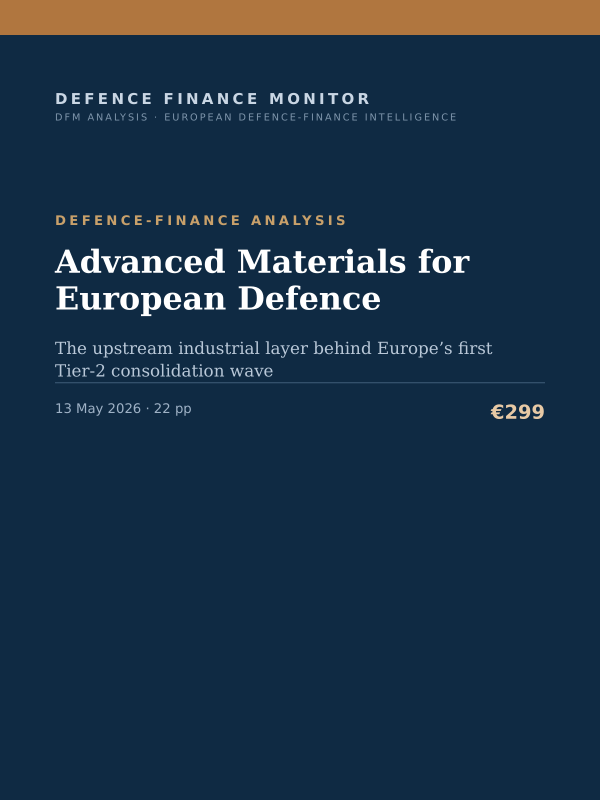 Full sourced report
Advanced Materials for European Defence
View the report →
Full sourced report
Advanced Materials for European Defence
View the report →
Keep getting the analysis
DFM publishes new analysis on Advanced Materials & Manufacturing every week.
Original DFM analysis
Advanced Materials For European Defence
The publication details above identify the source used for this public thread.
FAQ
What is Advanced Materials For European Defence?
The report is structured around this upstream sovereignty problem.
Why does Advanced Materials For European Defence matter for European defence?
It first places advanced materials within the EU’s defence-readiness, capability-development and critical-raw-materials framework, then maps the main sub-segments, suppliers and dependencies.
Related DFM Platform threads
Explore this category Strategic Autonomy
Professional requests (internal interest signal — not a marketplace; nothing is charged or promised)
See Professional & Institutional Access — plans, group/institutional seats and contact →
Defence Finance Monitor is an analytical and informational product. It does not constitute investment advice, financial advice or a recommendation to buy or sell securities. Subscriptions run on DFM Analysis. Payments for Professional Packs are processed securely by Stripe at checkout.