ITAR-Free Compliance: A Strategic Roadmap for US Tier-2 Defence Suppliers
From Chokepoints to Opportunity: Adapting US Subsystems to European Strategic Autonomy Requirements
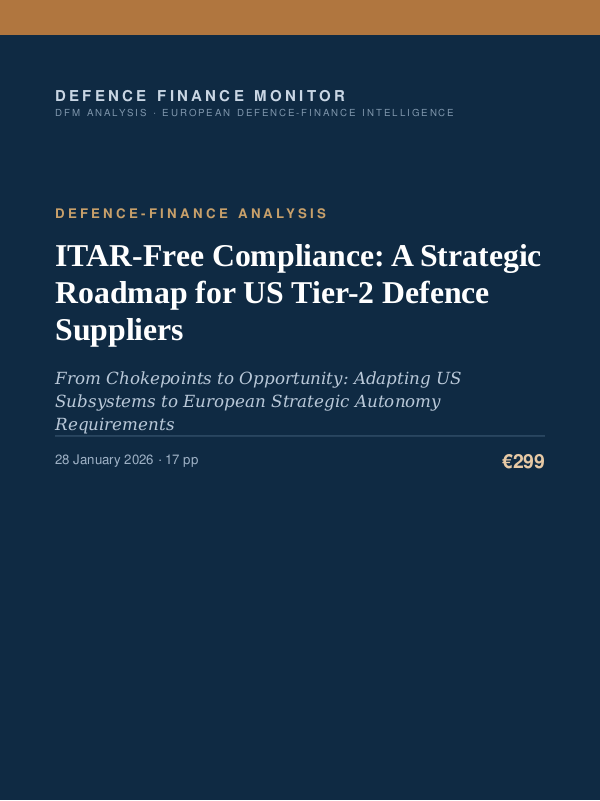
17 pages · PDF · Analysis as of 28 January 2026
€299 excl. VAT
- ✓ Instant PDF download — personal link valid 72 hours, up to 5 downloads
- ✓ VAT invoice issued for business purchases
- ✓ 17 pages · contents page · sources listed
- ✓ Purchase order, bank transfer or multiple copies: contact us
Get the free extract by email
The summary, the contents page and one sample page — sent to your inbox, with a follow on this theme so you get one alert when a new analysis lands. No charge.
Need a quote or invoice for your purchasing office?
Tell us the essentials and we'll send a formal quote or invoice — same listed price, purchase orders and multiple copies welcome.
What you'll learn
- The European Union has codified a legal link between industrial sovereignty and export autonomy, establishing “freedom of action” as a primary objective under Regulation (EU) 2021/697 (EDF).
- For US Tier-2 suppliers, this regulatory shift treats foreign export-control regimes—specifically the ITAR system—as a structural risk factor to be mitigated.
- Binding EU law now explicitly prioritizes “non-dependency on non-Union sources,” effectively creating a de jure perimeter that favors ITAR-free solutions.
Inside this report — 7 sections
- Legal and Regulatory Context
- ITAR Exposure as a Structural Risk
- Subsystem-Level Focus: Sensors and Propulsion
- EU Funding and Industrial Instruments
- Implications for US Tier-2 Suppliers
- Export Sovereignty and Third-Market Access
- Compliance, Governance, and Risk
≈ $327 — charged in euros; ECB reference rate.
A VAT invoice is issued for business purchases. One click to Stripe — guest checkout, no account. Download on the confirmation page and by e-mail (72 hours, up to 5 downloads).
Sold by STRONCATURE S.R.L. (VAT IT05960160652) · Prepared by the DFM research desk — editor: Nunzio Mastrolia.
Follow European defence funding & industry — free alerts: new analyses and updates on this theme
Key questions this report answers
- How does Regulation (EU) 2021/697 (EDF) codify a legal link between industrial sovereignty and export autonomy?
- Why does EU law treat ITAR exposure as a structural risk, and how does the 'non-dependency' perimeter favour ITAR-free solutions?
- What does this mean for US Tier-2 suppliers at the subsystem level (sensors, propulsion)?
- How should suppliers approach compliance, governance and third-market access?
Report structure — 7 sections
- Legal and Regulatory Contextp. 4
- ITAR Exposure as a Structural Riskp. 6
- Subsystem-Level Focus: Sensors and Propulsionp. 7
- EU Funding and Industrial Instrumentsp. 8
- Implications for US Tier-2 Suppliersp. 10
- Export Sovereignty and Third-Market Accessp. 12
- Compliance, Governance, and Riskp. 14
Sample page
One full page from the report, exactly as delivered (17 pages in total).

Sources — 9 cited (8 official and legal · 1 company · 0 press)
Official and legal sources (8)
- Regulatory Scrutiny and Investment Constraints: Lastly, a broader governance risk emerges: as Europe builds its own defence industrial base, there may be increased scrutiny on foreign investments and — eur-lex.europa.eu · 2009
- ec.europa.eu — document — ec.europa.eu
- eur-lex.europa.eu — document — eur-lex.europa.eu
- consilium.europa.eu — press release — consilium.europa.eu
- consilium.europa.eu — document — consilium.europa.eu
- defence-industry-space.ec.europa.eu — document — defence-industry-space.ec.europa.eu
- consilium.europa.eu — document — consilium.europa.eu
- consilium.europa.eu — press release — consilium.europa.eu
Company disclosures (1)
- globsec.org — document — globsec.org
Full source list, exactly as cited in the document (as of 28 January 2026). External links open in a new tab.
The analysis is public. The report is the document of record.
The analysis behind this report is published openly on DFM — that is how we work, and it does not change what you are buying. What you buy is the professional edition of that analysis: a dated, complete document with every source cited, structured for desk use, licensed to you, and citable in your own work. The free page is where the analysis lives; the report is what you file, rely on and cite.
Related reports
Methodology, format & delivery
DFM reports are built from primary and official sources — TED procurement notices, CORDIS and the EU Funding & Tenders Portal, EIB operations, the NATO Innovation Fund portfolio, SIPRI data, official budget documents and company disclosures — read together with the underlying legal texts. Sources are cited in the document; it reflects them as of its publication date (28 January 2026). You receive a 17-page report (PDF), watermarked to you on every page, delivered on the confirmation page and by e-mail immediately after checkout (personal link valid 72 hours, up to 5 downloads). Guest checkout, single-user licence — Terms of Sale.
Related on DFM
Read the free public analysis behind this report · More Operational reports · All reports
For your role
Investors
Investment intelligence on this company or segment
Request an investment-intelligence brief →SMEs & scale-ups
Position your capability with European programmes
Request a positioning & funding-eligibility check →Universities & research
Technology scouting and multi-seat access for your group
Request technology scouting / team access →Legal & compliance
Eligibility, export-control and regulatory analysis
Request a compliance analysis →Institutional & team access. Labs, primes and universities can equip a whole desk — multi-seat / institutional licensing. Request team / institutional access →
Stay on this subject
One alert when something moves: new calls, deadline changes, updated editions and related reports.
Follow — free alerts