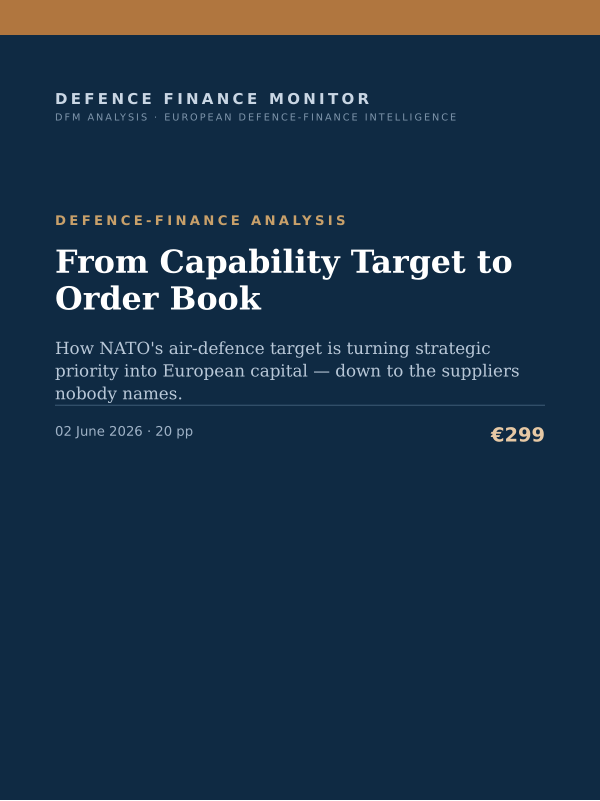
From Capability Target to Order Book
How NATO's air-defence target is turning strategic priority into European capital — down to the suppliers nobody names.
What this report establishes
“From Capability Target to Order Book” is a sourced, structured Defence Finance Monitor analysis, closed on 02 June 2026. It establishes what is at stake, who the actors are and what it means for European defence funding and industry — drawn only from primary and official sources. This page summarises what the 20-page report determines; the figures, the evidence and the conclusions are in the report itself.
Who it's for
Strategy, corporate-development and investment teams that need an ecosystem-level view — budgets, industrial capacity and technology landscapes — before committing capital or capacity.
Key questions this report answers
- Why has integrated air and missile defence become Europe's first-order problem, ranked first in NATO Capability Targets and EU Readiness 2030 priorities?
- How is the capability target institutionally translated into programmes, and how does the cost-per-kill constraint shape the capability stack?
- Which prime, tier-2 and tier-3 companies do the institutional filters elevate, and where is value created upstream?
- How are order books, re-rating and capital movement responding, and what institutional triggers will move capital next?
Inside this report
- 1. The priority: why air and missile defence became Europe’s first-order problem
- 2. The institutional translation: from capability target to programme
- 3. The capability stack and the cost-per-kill constraint
- 4. The companies the filters elevate
- 5. The tier-2 and tier-3 layer: where the priority creates value upstream
- 6. The capital movement: order books, re-rating, and the 2026 reassessment
- 7. What to watch: the institutional triggers that will move capital next
Sample page
One full page from the report, exactly as delivered (20 pages in total).

Sources
This report is built only from primary and official sources, cited in the document as of 02 June 2026 — 2 distinct sources including defence-industry-space.ec.europa.eu, nato.int. The source material itself is in the report, not on this page.
€299 excl. VAT — EU VAT calculated at checkout (VAT ID accepted for reverse charge); invoice issued after payment
≈ $335 — charged in euros; indicative equivalent at today's ECB reference rate.
Report — 20 pages · PDF · Analysis as of 02 June 2026 · Licensed single-user copy, watermarked to the buyer
A contents-paged report: a company's structure, portfolio, programme participation and funding record — or a market question measured with a stated method and full bibliography (Eurostat, TED, EU programme data). Use it to check a counterparty or a claim before committing time or budget.
This report €299 · All reports, the Funding Navigator and continuous updates — Annual Professional, €1,500/year excl. VAT →
One click to Stripe — guest checkout, no account. Your download appears on the confirmation page and arrives by e-mail right after payment (link valid 72 hours, up to 5 downloads).
Sold by STRONCATURE S.R.L. (VAT IT05960160652) · Secure checkout by Stripe · Instant watermarked PDF · EU invoice issued after payment.
Prepared by the DFM research desk — editor: Nunzio Mastrolia. Defence Finance Monitor is the defence-finance analysis publication of STRONCATURE S.R.L., Rome.
Keep getting the analysis
Not buying today? DFM Analysis — our free weekly briefing — covers the funding, programmes and companies behind reports like this one.
The analysis is public. The report is the document of record.
The analysis behind this report is published openly on DFM — that is how we work, and it does not change what you are buying. What you buy is the professional edition of that analysis: a dated, complete document with every source cited, structured for desk use, licensed to you, and citable in your own work. The free page is where the analysis lives; the report is what you file, rely on and cite.
What this report covers
Technologies: Energetics, Propellants & Smart Munitions. A sourced, structured 20-page analysis for European defence and dual-use decision-makers, from the DFM research desk and built on official and primary sources.
Related reports
Methodology, format & delivery
DFM reports are built from primary and official sources — TED procurement notices, CORDIS and the EU Funding & Tenders Portal, EIB operations, the NATO Innovation Fund portfolio, SIPRI data, official budget documents and company disclosures — read together with the underlying legal texts. Sources are cited in the document; it reflects them as of its publication date (02 June 2026). You receive a 20-page report (PDF), watermarked to you on every page, delivered on the confirmation page and by e-mail immediately after checkout (personal link valid 72 hours, up to 5 downloads). Guest checkout, single-user licence — Terms of Sale.
Related on DFM
Read the free public analysis behind this report · More Strategic reports · Energetics, Propellants & Smart Munitions · All reports
For your role
Investors
Investment intelligence on this company or segment
Request an investment-intelligence brief →SMEs & scale-ups
Position your capability with European programmes
Request a positioning & funding-eligibility check →Universities & research
Technology scouting and multi-seat access for your group
Request technology scouting / team access →Legal & compliance
Eligibility, export-control and regulatory analysis
Request a compliance analysis →Institutional & team access. Labs, primes and universities can equip a whole desk — multi-seat / institutional licensing. Request team / institutional access →
Prefer unlimited access?
Prefer unlimited access? Every report like this is included in the DFM Analysis subscription. See plans →