Capability
The Two-Speed Fiscal Architecture of European Defence
How does Europe's layered fiscal architecture give some Member States more room than others to fund defence procurement and industrial capacity?
The Two-Speed Fiscal Architecture of European Defence: Europe’s defence build-up is no longer. Defence-finance analysis; 18-page sourced DFM PDF report.
This public thread presents the concise analytical answer. The complete evidence, source base and assessment are available below.
Part of our Policy, Procurement & Institutions and Investors & Capital Allocators coverage →
Original DFM publication · DFM Analysis report · 2026-05-15
Europe’s defence build-up is no longer driven only by strategic urgency or national political will. It is increasingly shaped by a layered fiscal architecture that gives some Member States more room than others to convert defence priorities into funded procurement, industrial capacity and investable order visibility.
The interaction between National Escape Clause activation, SAFE loan participation, proposed MFF 2028–2034 defence funding and enhanced-cooperation borrowing for Ukraine is beginning to redraw the map of European defence investment.
This analysis answers: How does Europe's layered fiscal architecture give some Member States more room than others to fund defence procurement and industrial capacity? How do National Escape Clause activation and SAFE loan participation interact as financing layers? How do proposed MFF 2028-2034 defence funding and enhanced-cooperation borrowing for Ukraine reshape the fiscal-space map? What industrial, equity and M&A consequences follow from this two-speed fiscal architecture?
Choose how to continue
Go deeper on this question
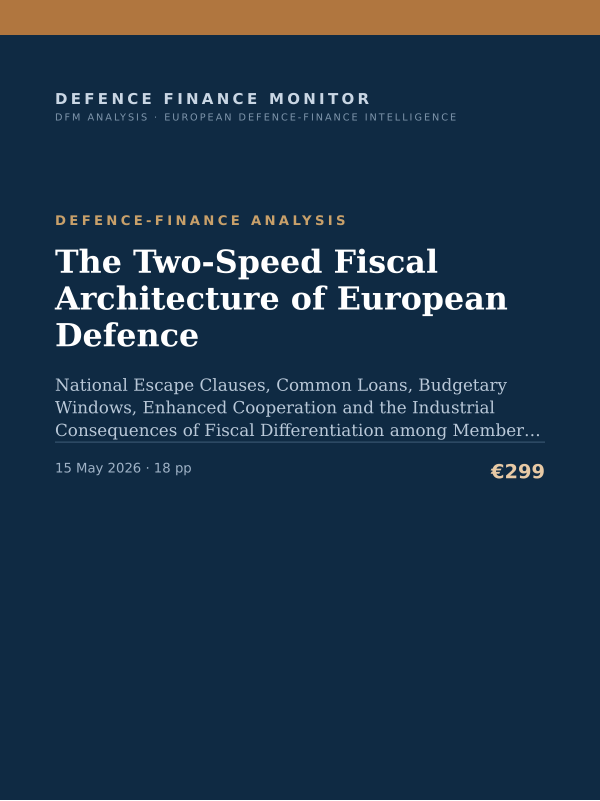 Full sourced report
The Two-Speed Fiscal Architecture of European Defence
View the report →
Full sourced report
The Two-Speed Fiscal Architecture of European Defence
View the report →
Keep getting the analysis
DFM publishes new defence-finance analysis every week.
Original DFM analysis
The Two-Speed Fiscal Architecture of European Defence
The publication details above identify the source used for this public thread.
Related DFM Platform threads
- Europe's High-Low Arsenal: $50.66bn Pledged to Deep Strike, and the Magazine No Public Record Sets
- UK's £400k Strike Weapon vs the $4m PAC-3 MSE: Why Cheap Autonomy Forces Europe to Buy More Layers, Not Fewer
- PAC-3, SAMP/T and Europe's Missile Constraint: Can Cheap Unmanned Mass Substitute for the Expensive Upper Layer?
Explore this category Strategic Autonomy
Professional requests (internal interest signal — not a marketplace; nothing is charged or promised)
See Professional & Institutional Access — plans, group/institutional seats and contact →
Defence Finance Monitor is an analytical and informational product. It does not constitute investment advice, financial advice or a recommendation to buy or sell securities. Subscriptions run on DFM Analysis. Payments for Professional Packs are processed securely by Stripe at checkout.