Capability
The Baltic Defence Line 2025: Contract Intelligence and Capital Investment Analysis on Fortifications and Electronic Border Surveillance
What is the strategic, technological and financial relevance of The Baltic Defence Line 2025 for European defence autonomy and allied capability?
The Baltic Defence Line represents a pivotal evolution in NATO’s eastern flank security, transitioning from a reactive posture to a proactive “deterrence-by-denial”…
This public thread presents the concise analytical answer. The complete evidence, source base and assessment are available below.
Part of our Global Defence Institutions and Policy, Procurement & Institutions coverage →
Original DFM publication · DFM Analysis report · 2025-12-23
The Baltic Defence Line represents a pivotal evolution in NATO’s eastern flank security, transitioning from a reactive posture to a proactive “deterrence-by-denial” strategy. Formally initiated on 19 January 2024 by Estonia, Latvia, and Lithuania, the Baltic Defence Line is progressing through a phased implementation of counter-mobility and fortification measures, with nationally managed procurement and engineering works advancing at different speeds across the three countries. By late 2025, the initiative had entered tangible implementation phases, including Estonia’s pilot deployment of bunkers and the start of anti-tank ditch construction, alongside the procurement and pre-positioning of counter-mobility materials across participating states. Coordinated with Poland’s parallel “East Shield” (Tarcza Wschód) program, the initiative establishes a continuous 1,360 km defensive perimeter, operationalizing NATO’s Madrid Summit mandate to defend allied territory from the “first meter. Central to this multifaceted defensive architecture is a robust framework of contract intelligence and capital investment analysis. The deployment of a digital backbone—comprised of secure fiber-optic networks, seismic sensors, and AI-driven automated surveillance—complements physical fortifications to deliver real-time situational awareness and rapid command-and-control (C2) integration. Key procurement milestones, such as Latvia’s €50 million acquisition of the Skorpion-2 remote minelaying system and Estonia’s modular bunker production, underscore a strategic allocation of risk and a high degree of regional industrial participation.
Choose how to continue
Go deeper on this question
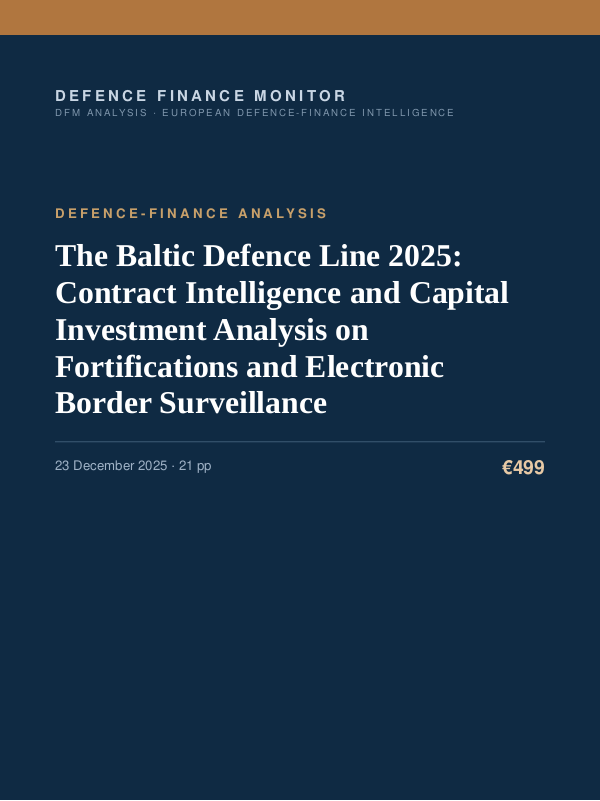 Full sourced report
The Baltic Defence Line 2025: Contract Intelligence and Capital Investment Analysis on Fortifications and Electronic Border Surveillance
View the report →
Full sourced report
The Baltic Defence Line 2025: Contract Intelligence and Capital Investment Analysis on Fortifications and Electronic Border Surveillance
View the report →
Keep getting the analysis
DFM publishes new defence-finance analysis every week.
Original DFM analysis
The Baltic Defence Line 2025: Contract Intelligence and Capital Investment Analysis on Fortifications and Electronic Border Surveillance
The publication details above identify the source used for this public thread.
FAQ
What is The Baltic Defence Line 2025: Contract Intelligence and Capital Investment Analysis on Fortifications and Electronic Border Surveillance?
The Baltic Defence Line represents a pivotal evolution in NATO’s eastern flank security, transitioning from a reactive posture to a proactive “deterrence-by-denial” strategy.
Related DFM Platform threads
Explore this category Strategic Autonomy
Professional requests (internal interest signal — not a marketplace; nothing is charged or promised)
See Professional & Institutional Access — plans, group/institutional seats and contact →
Defence Finance Monitor is an analytical and informational product. It does not constitute investment advice, financial advice or a recommendation to buy or sell securities. Subscriptions run on DFM Analysis. Payments for Professional Packs are processed securely by Stripe at checkout.