Capability
Proton AG: CERN Spin-Out at the Centre of Europe's Encryption Debate
What is the strategic, technological and financial relevance of Proton AG for European defence autonomy and allied capability?
Proton AG began in 2013, when three physicists working on experiments at CERN — Andy Yen, Jason Stockman and Wei Sun — decided that email deserved the s…
This public thread presents the concise analytical answer. The complete evidence, source base and assessment are available below.
Part of our Defence & Dual-Use Companies and Policy, Procurement & Institutions coverage →
Original DFM publication · DFM Analysis report · 2026-02-02
Analysis as of 2 February 2026.
Proton AG began in 2013, when three physicists working on experiments at CERN — Andy Yen, Jason Stockman and Wei Sun — decided that email deserved the same rigour as particle detection. Roughly three hundred colleagues at the laboratory tried the early builds of what became ProtonMail. Twelve years on, the Geneva firm reports a user base in the neighbourhood of one hundred million, of whom about four in ten sit inside the EU, and it has grown well beyond mail into VPN tunnelling, encrypted storage and calendars, and most recently Lumo, an assistant built so that AI queries stay unreadable to the operator itself. Brussels noticed early: a €2 million Horizon 2020 award arrived in 2019 through the SME Instrument, and the ProtonSuite project — grant agreement 848554, a total budget near €2.7 million — put EU money behind an integrated encrypted collaboration stack with blockchain-anchored key handling.
Two structural moves define the company's current posture. In mid-2024 the founders transferred a controlling block of shares to a newly created Swiss non-profit, the Proton Foundation, whose trustees include Tim Berners-Lee and the UK ethicist Carissa Véliz; the point was to lock the mission against future shareholder pressure. And the infrastructure map is drifting toward the Union: alongside Swiss data centres, a planned CHF 100 million commitment will place AI compute in Germany and Norway — a decision the leadership has openly tied to distrust of proposed Swiss surveillance rules. The workforce tells a similar story: around a fifth of staff work from Prague and Vilnius, and about half the payroll holds EU citizenship. Acquisitions of SimpleLogin in 2022 and Standard Notes in 2024 rounded out the product family.
Why does a consumer privacy firm belong in defence-finance coverage? Because encrypted communications are dual-use by definition — end-to-end cryptography falls under the Wassenaar arrangement and EU dual-use rules — and because European institutions are already customers: administrations in Germany, Croatia and the Vatican have adopted Proton services. As the EU pushes to reduce exposure to American cloud and mail providers, a mature, high-readiness encryption supplier operating under Swiss law, majority-owned by a non-profit and free of flagged foreign capital, looks like exactly the kind of asset sovereignty strategies are written for. Confidential command, diplomatic and logistics traffic all depend on the layer Proton sells commercially.
Yet the programmatic record is strikingly thin. Beyond the two Horizon 2020 engagements, DFM found no trace of Proton in the European Defence Fund, PESCO, EDIDP, SAFE lending, STEP seals or NATO science channels, and no subcontracting position beneath primes such as Airbus or Thales. There is no accreditation for classified networks, no published bill-of-materials assurance on hardware provenance, and Switzerland's status as a non-EU partner complicates some procurement routes. The company is strategically aligned but institutionally absent — a sovereign-grade capability sitting outside every sovereign framework. DFM's structured assessment scores the firm 7 out of 10, a significant contributor to European defence sovereignty whose rating is capped precisely by that missing integration.
Four determinations run through the full profile, each weighed against evidence rather than asserted. Whether a Swiss entity controlled by a foundation can pass the EDIP and SAFE eligibility screens at all, or jurisdiction is the binding constraint. What certification for classified communications would require, and which EDF or EDA pathways could realistically deliver it. Whether the Germany–Norway infrastructure build marks the start of a genuine migration into EU jurisdiction, or a hedge against one Swiss statute. And whether, if Proton never enters formal defence programmes, its civilian ubiquity still delivers resilience value that procurement frameworks fail to measure. The report closes on 2 February 2026 with the record assembled for each — including the question of what undocumented hardware provenance means for a software-first supplier.
Choose how to continue
Go deeper on this question
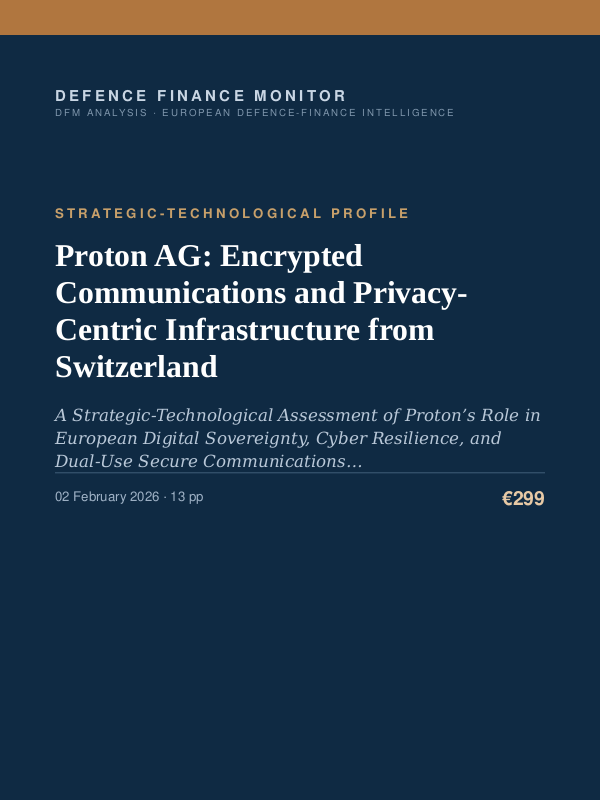 Full sourced report
Proton AG: Encrypted Communications and Privacy-Centric Infrastructure from Switzerland
View the report →
Full sourced report
Proton AG: Encrypted Communications and Privacy-Centric Infrastructure from Switzerland
View the report →
Keep getting the analysis
DFM publishes new analysis on Cyber & Electronic Warfare every week.
Original DFM analysis
Proton AG: Encrypted Communications and Privacy-Centric Infrastructure from Switzerland
The publication details above identify the source used for this public thread.
Related DFM Platform threads
Explore this category Strategic Autonomy
Professional requests (internal interest signal — not a marketplace; nothing is charged or promised)
See Professional & Institutional Access — plans, group/institutional seats and contact →
Defence Finance Monitor is an analytical and informational product. It does not constitute investment advice, financial advice or a recommendation to buy or sell securities. Subscriptions run on DFM Analysis. Payments for Professional Packs are processed securely by Stripe at checkout.