Capability
Strategic-Technological Assessment Of IQE PLC
Strategic-Technological Assessment of IQE PLC: what capability does it address, and how mature is it?
IQE plc occupies a strategically significant position within the defence and dual-use technology ecosystem because it operates at a layer of the industrial stack that is rarely visible but often decisive: the production…
This public thread presents the concise analytical answer. The complete evidence, source base and assessment are available below.
Part of our Defence & Dual-Use Companies and Policy, Procurement & Institutions coverage →
Platform publication · DFM Analysis report · 2026-06-28
IQE plc occupies a strategically significant position within the defence and dual-use technology ecosystem because it operates at a layer of the industrial stack that is rarely visible but often decisive: the production of compound semiconductor epitaxial wafers that enable high-performance radio-frequency, photonic, infrared and satellite-communications systems. In a European context increasingly shaped by supply-chain de-risking, microelectronics security and stricter sovereignty conditions in defence procurement, the company’s relevance lies less in platform integration than in its role as a specialist upstream enabler of critical performance across multiple operational domains. Its technological significance derives from the fact that advanced sensing, electronic warfare and secure communications architectures depend not only on system design, but on trusted access to specialised materials and manufacturing know-how at wafer level.
This makes IQE a useful case through which to examine how industrial depth, allied-location manufacturing and compound semiconductor capability intersect with Europe’s broader search for strategic autonomy. IQE plc is a specialist producer of epitaxial wafer materials that sit at the hidden core of high‑performance radio‑frequency and photonics systems. From a European strategic autonomy perspective, this industrial niche matters because the performance ceiling of many defence sensors and communications chains is set upstream, at the material layer.
Compound semiconductor epitaxy shapes whether radar front ends can move to higher powers and higher frequencies, whether secure satellite links can deliver bandwidth under contested conditions, and whether infrared sensing can scale without disproportionate size, weight and power penalties. European and allied policy frameworks increasingly treat microelectronics supply security as a strategic vulnerability, not merely an industrial concern. The European Chips Act explicitly frames resilience, supply‑chain security and reduced external dependencies as core objectives for the Union’s semiconductor ecosystem.
Choose how to continue
Go deeper on this question
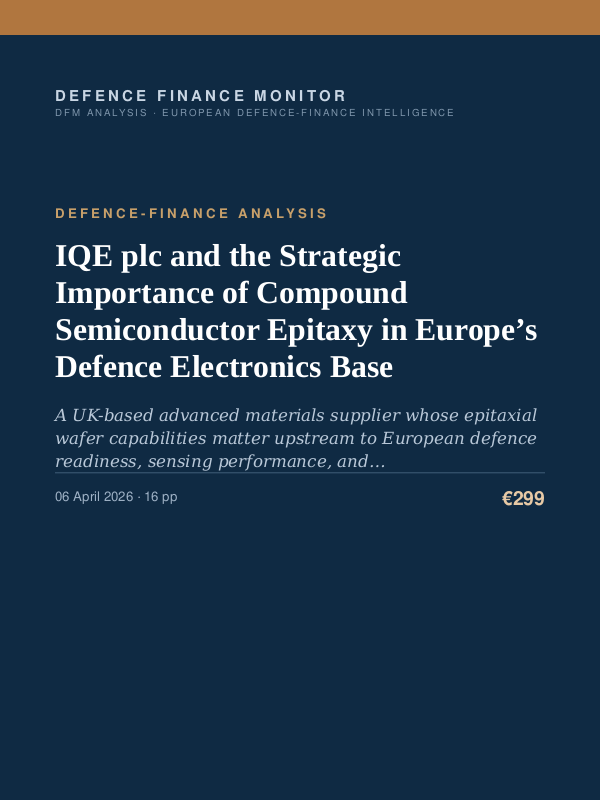 Full sourced report
IQE plc and the Strategic Importance of Compound Semiconductor Epitaxy in Europe’s Defence Electronics Base
View the report →
Full sourced report
IQE plc and the Strategic Importance of Compound Semiconductor Epitaxy in Europe’s Defence Electronics Base
View the report →
Keep getting the analysis
DFM publishes new analysis on Microelectronics, Quantum & Biotechnology every week.
Original DFM analysis
Strategic-Technological Assessment Of IQE PLC
The publication details above identify the source used for this public thread.
Related DFM Platform threads
Explore this category Strategic Autonomy
Professional requests (internal interest signal — not a marketplace; nothing is charged or promised)
See Professional & Institutional Access — plans, group/institutional seats and contact →
Defence Finance Monitor is an analytical and informational product. It does not constitute investment advice, financial advice or a recommendation to buy or sell securities. Subscriptions run on DFM Analysis. Payments for Professional Packs are processed securely by Stripe at checkout.