Funding Eligibility
From National SAFE Plans to a European Defence-Finance Execution Cycle
What is the strategic, technological and financial relevance of From National SAFE Plans to a European Defence-Finance Execution Cycle for European defence autonomy and allied capability?
How the first SAFE endorsements under Regulation (EU) 2025/1106 turn Readiness 2030 into a time-bound demand signal for industry and investors.
This public thread presents the concise analytical answer. The complete evidence, source base and assessment are available below.
Part of our Policy, Procurement & Institutions and Defence & Dual-Use Companies coverage →
Original DFM publication · DFM Analysis report · 2026-01-25
The European Union is entering a phase in which the decisive variable for defence-industrial outcomes is no longer the density of strategic declarations, but the operational credibility of the financing architecture that sits behind them: whether EU-level instruments can provide low-cost, time-bound liquidity that Member States can absorb quickly, translate into executable joint procurement, and convert into predictable industrial throughput. In this setting, the key question is not whether Europe intends to spend more, but whether it can structure demand at scale, reduce fragmentation in acquisition, and accelerate production across priority capability areas without being slowed by national administrative bottlenecks, divergent specifications, and contracting timelines that are misaligned with readiness requirements. The activation of SAFE under Regulation (EU) 2025/1106 is therefore best read as an initial stress test of the Union’s capacity to turn Readiness 2030 from a mobilisation narrative into a measurable market signal: one that can be priced, financed, and acted upon by governments, prime contractors, and the wider tiered supply chain. The European Union is moving from a posture centred on coordination to one of direct financial enablement of defence-industrial capacity, using instruments intended to translate strategic priorities into financeable demand.
Choose how to continue
Go deeper on this question
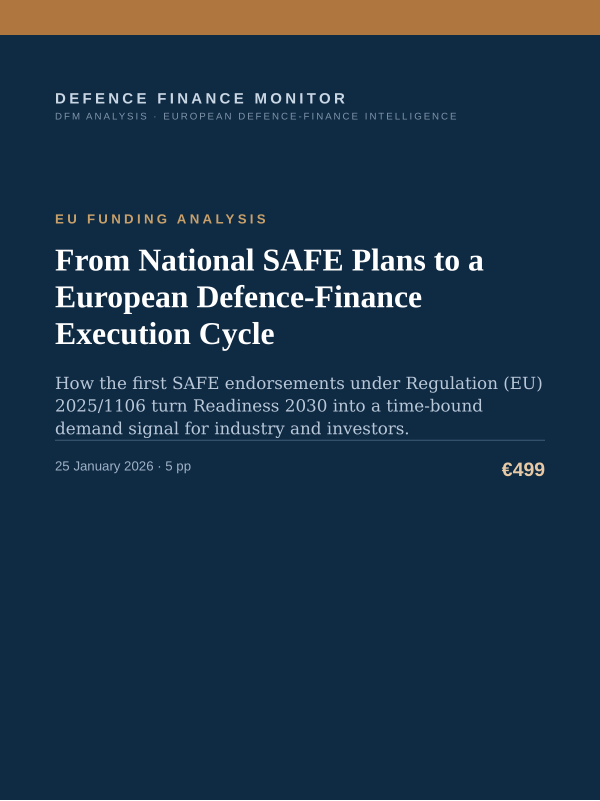 Full sourced report
From National SAFE Plans to a European Defence-Finance Execution Cycle
View the report →
Full sourced report
From National SAFE Plans to a European Defence-Finance Execution Cycle
View the report →
Keep getting the analysis
DFM publishes new defence-finance analysis every week.
Original DFM analysis
From National SAFE Plans to a European Defence-Finance Execution Cycle
The publication details above identify the source used for this public thread.
Related DFM Platform threads
Explore this category Funding & Eligibility
Professional requests (internal interest signal — not a marketplace; nothing is charged or promised)
See Professional & Institutional Access — plans, group/institutional seats and contact →
Defence Finance Monitor is an analytical and informational product. It does not constitute investment advice, financial advice or a recommendation to buy or sell securities. Subscriptions run on DFM Analysis. Payments for Professional Packs are processed securely by Stripe at checkout.