Funding Eligibility
Isar Aerospace and European Launch Autonomy
What does Isar Aerospace signal for European launch autonomy and defence funding, and who can actually access that capability?
Isar Aerospace and the push for European launch autonomy: what independent access to orbit means for defence funding, and which players can realistically scale.
This public thread presents the concise analytical answer. The complete evidence, source base and assessment are available below.
Part of our Defence & Dual-Use Companies and Policy, Procurement & Institutions coverage →
Platform publication · DFM Analysis report · 2026-06-17
Europe's ability to put its own satellites into orbit has entered a pivotal new era, driven by an ambitious startup aiming to fill the gap left by retired and unavailable launchers. Isar Aerospace, a German NewSpace company founded in 2018, is building lightweight orbital rockets to ensure that European institutions and businesses are no longer dependent on foreign launch providers.
Independent access to orbit is a strategic capability in its own right, because satellites underpin communications, navigation, timing and earth observation that defence and civil infrastructure both rely on. A European launch provider reduces dependence on foreign or unavailable launchers, but the capability question is whether lightweight orbital rockets can be produced reliably, cadenced frequently and priced competitively. For institutions and businesses across Europe, the value lies less in any single launch than in a sovereign, repeatable path to orbit that is not subject to external constraints during a crisis. Sovereign launch also changes the calculus for adjacent capabilities, since responsive, affordable access shapes how satellite constellations can be planned, replenished and defended.
On funding and eligibility, the decisive issue is how public and private capital, and the criteria attached to it, determine which launch innovators can scale from prototype to operational service. Readers should examine the structure of that funding, the realism of stated launch cadences, and how procurement of launch services is likely to consolidate around a small number of viable providers. The market reward favours those who reach reliable, repeatable service first, so timing and execution matter as much as technology, and a single delay can reshape who survives the transition. The strategic question is whether European demand and policy are coordinated enough to sustain more than one credible domestic provider. The full DFM Analysis report sets out the complete source base, the supporting figures and the detailed assessment behind this view.
Choose how to continue
Go deeper on this question
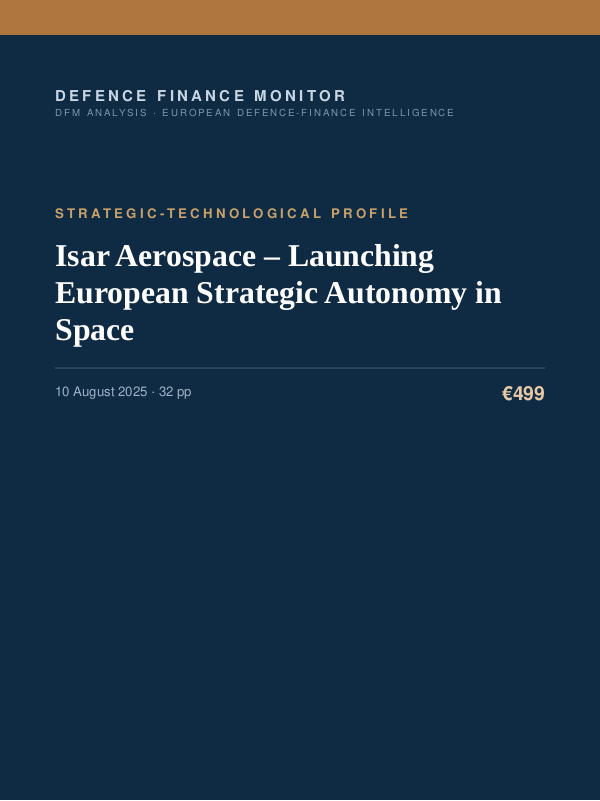 Full sourced report
Isar Aerospace – Launching European Strategic Autonomy in Space
View the report →
Full sourced report
Isar Aerospace – Launching European Strategic Autonomy in Space
View the report →
Keep getting the analysis
DFM publishes new analysis on Space, Satellites & PNT every week.
Original DFM analysis
Isar Aerospace Launching European
The publication details above identify the source used for this public thread.
Related DFM Platform threads
Explore this category Funding & Eligibility
Professional requests (internal interest signal — not a marketplace; nothing is charged or promised)
See Professional & Institutional Access — plans, group/institutional seats and contact →
Defence Finance Monitor is an analytical and informational product. It does not constitute investment advice, financial advice or a recommendation to buy or sell securities. Subscriptions run on DFM Analysis. Payments for Professional Packs are processed securely by Stripe at checkout.