Capability
Critical Single-Source Dependencies in European Missile Defence Supply Chains
Critical Single Source Dependencies: what advance does it represent, and where does it matter for European defence?
European missile defence capabilities increasingly depend on complex, multi-layered industrial ecosystems in which sovereignty at the system-integration level coexists with dependence at upstream technological…
This public thread presents the concise analytical answer. The complete evidence, source base and assessment are available below.
Part of our Policy, Procurement & Institutions and Defence & Dual-Use Companies coverage →
Platform publication · DFM Analysis report · 2026-06-28
European missile defence capabilities increasingly depend on complex, multi-layered industrial ecosystems in which sovereignty at the system-integration level coexists with dependence at upstream technological and material layers. While Europe has strengthened its position in the design, integration, and deployment of air and missile defence systems, there is growing concern that critical vulnerabilities persist in areas that are not immediately visible at prime-contractor level. These vulnerabilities do not necessarily take the form of general external dependence, but rather of concentrated exposures at specific points in the supply chain, where a limited number of non-European actors control essential inputs.
The central analytical problem is therefore not whether Europe depends on external suppliers in general, but whether it is exposed to single-source or near-single-source chokepoints that could materially disrupt development, production, or sustainment cycles under geopolitical or export-control pressure. The report addresses this problem through a strict evidentiary framework that distinguishes between four categories of dependency: publicly evidenced single-source dependency, near-single-source dependency, structural extra-European dependency, and unresolved dependency. It proceeds by analysing the missile defence supply chain by industrial layer, beginning with semiconductor design toolchains and fabrication dependencies, and extending to key electronic components, photonics and optical subsystems, advanced materials, and propulsion-related inputs.
Each layer is assessed against publicly available institutional, regulatory, and technical sources, with a clear separation between documented evidence and analytical inference. The report also examines the extent to which European policy instruments, including EDIP, EDIRPA, and related frameworks, reflect institutional recognition of these vulnerabilities, and whether programme-level initiatives provide indirect signals of unresolved technological or industrial gaps.
Choose how to continue
Go deeper on this question
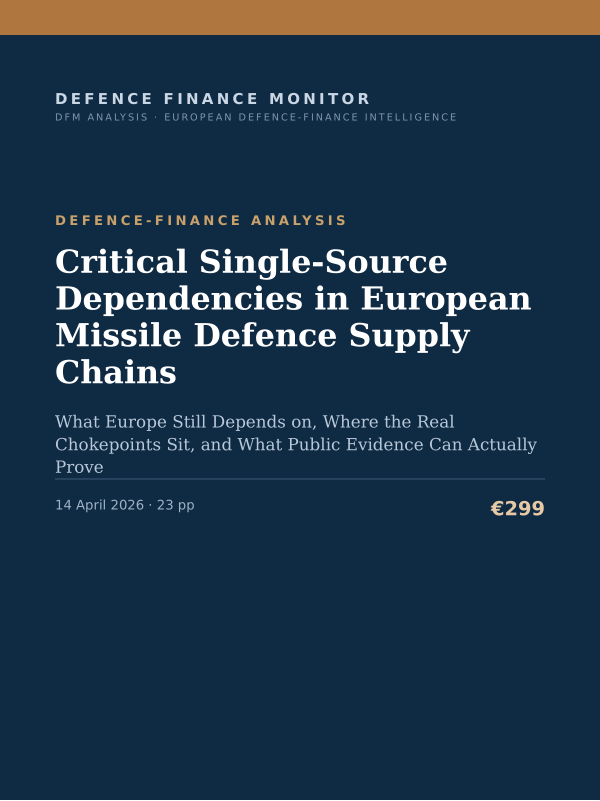 Full sourced report
Critical Single-Source Dependencies in European Missile Defence Supply Chains
View the report →
Full sourced report
Critical Single-Source Dependencies in European Missile Defence Supply Chains
View the report →
Keep getting the analysis
DFM publishes new defence-finance analysis every week.
Original DFM analysis
Critical Single Source Dependencies
The publication details above identify the source used for this public thread.
Related DFM Platform threads
Explore this category Strategic Autonomy
Professional requests (internal interest signal — not a marketplace; nothing is charged or promised)
See Professional & Institutional Access — plans, group/institutional seats and contact →
Defence Finance Monitor is an analytical and informational product. It does not constitute investment advice, financial advice or a recommendation to buy or sell securities. Subscriptions run on DFM Analysis. Payments for Professional Packs are processed securely by Stripe at checkout.