Capability
Air and Missile Defence Returns to the EDF 2026 Cycle
Air and Missile Defence Returns to: what does it mean for European defence funding and who can access it?
The return of Air and Missile Defence in the European Defence Fund Work Programme 2026 is analytically important not because it confirms that integrated air and missile defence remains a political and capability…
This public thread presents the concise analytical answer. The complete evidence, source base and assessment are available below.
Part of our Policy, Procurement & Institutions and Defence & Dual-Use Companies coverage →
Platform publication · DFM Analysis report · 2026-06-24
The return of Air and Missile Defence in the European Defence Fund Work Programme 2026 is analytically important not because it confirms that integrated air and missile defence remains a political and capability priority, which was already clear, but because it does so through a narrow and technically demanding funding configuration. The relevant question is not whether air defence matters, but what this specific configuration reveals about the actual state of European collaborative R&D in the field. The two topics funded in 2026 suggest a move away from broad signalling and toward a more selective phase centred on high-end endo-atmospheric interception and counter-hypersonic glide vehicle work, where technological depth, programme continuity, security conditions, and consortium feasibility matter as much as formal eligibility.
In that sense, AIRDEF 2026 is best read as a concentrated industrial signal rather than as a generic reopening of a defence category. The report is structured to test that proposition against documentary evidence rather than institutional rhetoric. It begins by reconstructing the legal, budgetary, and programmatic baseline from EDF, SAFE, EDA, and company primary sources, keeping strictly separate what is law in force, what is programme design, what is planning intent, and what is only company positioning.
It then develops an analytical reading of the 2026 AIRDEF configuration, focusing on technological maturation, the gap between formal eligibility and the realistic applicant pool, the conditional relationship between EDF development lines and future SAFE-relevant procurement, and the industrial categories most structurally aligned with the call design. A third part examines the implications for investors, prime contractors, procurement specialists, and EU policymakers, before a final section identifies the concrete signals that would strengthen, weaken, or revise the report’s conclusions over the next twelve months. The analytically relevant tension in the 2026 reappearance of Air and Missile Defence (AIRDEF) inside the EDF is not whether integrated air and missile defence is politically urgent or capability-relevant.
Key takeaways
- The report is structured to test that proposition against documentary evidence rather than institutional rhetoric.
- It begins by reconstructing the legal, budgetary, and programmatic baseline from EDF, SAFE, EDA, and company primary sources, keeping strictly separate what is law in force, what is programme design…
- A third part examines the implications for investors, prime contractors, procurement specialists, and EU policymakers, before a final section identifies the concrete signals that would strengthen, weaken…
Choose how to continue
Go deeper on this question
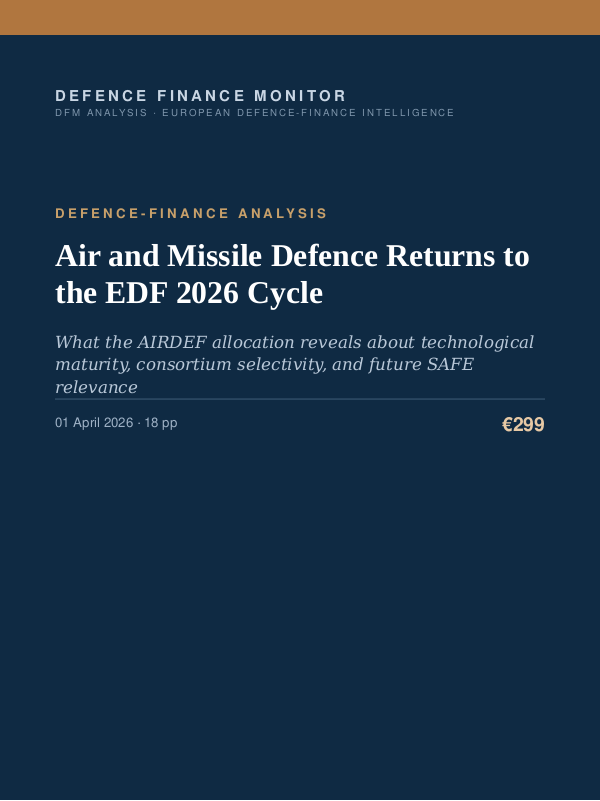 Full sourced report
Air and Missile Defence Returns to the EDF 2026 Cycle
View the report →
Full sourced report
Air and Missile Defence Returns to the EDF 2026 Cycle
View the report →
Keep getting the analysis
DFM publishes new defence-finance analysis every week.
Original DFM analysis
Air And Missile Defence Returns To
The publication details above identify the source used for this public thread.
FAQ
What is Air and Missile Defence Returns to the EDF 2026 Cycle?
In that sense, AIRDEF 2026 is best read as a concentrated industrial signal rather than as a generic reopening of a defence category.
Why does Air and Missile Defence Returns to the EDF 2026 Cycle matter for European defence?
It then develops an analytical reading of the 2026 AIRDEF configuration, focusing on technological maturation, the gap between formal eligibility and the realistic applicant pool…
Related DFM Platform threads
Explore this category Strategic Autonomy
Professional requests (internal interest signal — not a marketplace; nothing is charged or promised)
See Professional & Institutional Access — plans, group/institutional seats and contact →
Defence Finance Monitor is an analytical and informational product. It does not constitute investment advice, financial advice or a recommendation to buy or sell securities. Subscriptions run on DFM Analysis. Payments for Professional Packs are processed securely by Stripe at checkout.