Thematic analyses on supply chains, EU funding rules and the sites and
programmes behind them, plus eligibility reports and company profiles. Each is a dated, sourced
PDF, watermarked to the buyer and delivered immediately after checkout — one-off purchase, no
subscription, no account.
In focus this week (€299 thematic analyses, chosen by search demand, rotates weekly)
The operational vulnerability that “Undersea Infrastructure Security Plans” implicitly seeks to mitigate is the absence of a sufficiently integrated, exercised, and scalable security-and-resilience system for critical…
The operational vulnerability addressed by Integrated Missile Defence Networks is the persistent inability to generate and sustain a resilient, Alliance-wide “sensor–decision–effector” chain for missile and air defence…
The operational problem addressed by “High-Intensity Multidomain Exercises” is not the absence of exercise activity in general, but a structural deficit in the Alliance’s ability to rehearse, at sufficient scale and…
The operational vulnerability addressed by this priority is the absence, or uneven maturity, of a systematic and operationally integrated capacity to assess how climate change and climate-driven extremes affect force…
The operational priority commonly described as “Rapid Deployment & Crisis Response Forces” is best reconstructed as a structural vulnerability: the inability to assemble, move, insert, and sustain interoperable joint…
The core operational failure mode addressed by “Peacekeeping & Evacuation Operations” is the inability to generate, deploy, command, protect, and sustain forces at sufficient speed and scale to secure civilians and…
Within the Defence Finance Monitor framing, “Nuclear Sharing & Dual-Capable Aircraft Integration” is best reconstructed as an operational vulnerability rather than as a programme label.
The operational vulnerability addressed by “Quantum, Cyber and Space R&D Initiatives” can be characterised as a growing risk of operational paralysis in high-intensity and hybrid confrontation due to insufficiently…
“Strategic Signalling & Nuclear Exercises” addresses an operational vulnerability that is increasingly salient in the post‑February 2022 security environment: the risk that NATO’s nuclear deterrence posture…
Artificial intelligence and autonomous systems are increasingly framed within NATO and EU strategy as determinants of operational tempo, resilience, and scalable mass rather than as isolated innovation projects.
The operational failure mode addressed by “Strategic Nuclear Command, Control & Communications (NC3)” is the risk that, in a high-stress crisis or conflict with a nuclear dimension, Alliance and national political…
The operational vulnerability addressed by “Sustainable Military Mobility (Alternative Fuels)” can be reconstructed as a compound sustainment failure mode that emerges when armed forces must conduct rapid reinforcement…
Green procurement and supply-chain decarbonisation are increasingly being treated within NATO and the European Union as enabling conditions for readiness, resilience, and industrial continuity rather than as peripheral…
The operational vulnerability addressed by “Warhead Security & Transport Safety” is the risk that allied nuclear warheads and warhead-related components cannot be maintained in assured custody and moved safely…
“Energy Resilience of Bases & Deployed Forces” addresses a recurring operational failure mode: the inability of fixed installations and deployed formations to sustain assured power and fuel under disruption, whether…
The European Defence Projects of Common Interest (EDPCIs) are formally defined by Regulation (EU) 2025/2643 (the European Defence Industry Programme, EDIP).
“Strategic Communications” has emerged as a dedicated operational priority to secure the information domain against adversary manipulation and to project a unified narrative of Allied intent.
The European Union has codified a legal link between industrial sovereignty and export autonomy, establishing “freedom of action” as a primary objective under Regulation (EU) 2021/697 (EDF).
The execution phase of the European Defence Industry Programme (EDIP) introduces a specialized financial pillar designed to bridge the liquidity gap for high-growth hardware manufacturing: the Fund Accelerating Defence…
This report models autonomous aerial systems as a layered technology stack—sensing and perception, guidance and flight control, mission autonomy, communications, and off-board control infrastructure—and explains why…
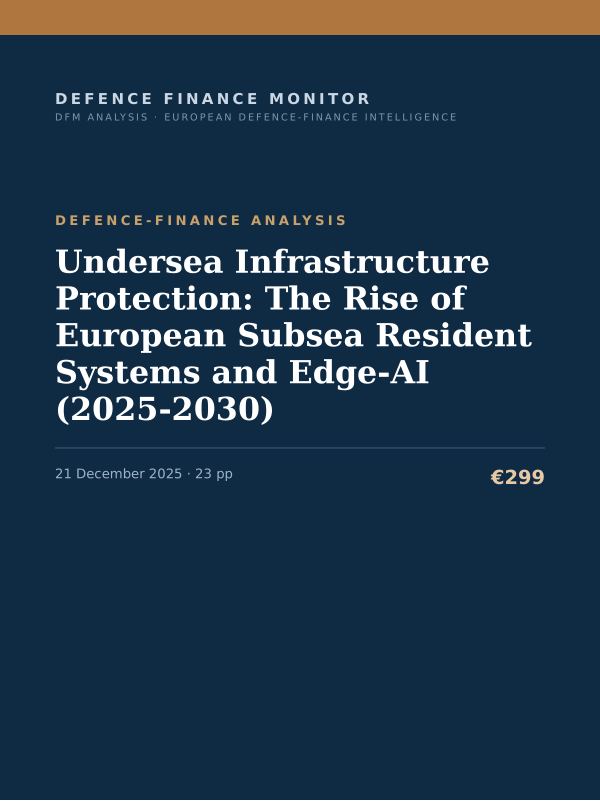
Europe’s undersea cables, energy pipelines, and seabed installations form a largely invisible layer of strategic infrastructure that underwrites economic continuity, military mobility, and political stability.
The strategic landscape of 2025 marks a definitive pivot in European industrial doctrine, as the European Union transitions from market-led procurement to a security-first sourcing regime.
In the decade preceding 2022, Europe’s defence financing was characterised by restraint, institutional fragmentation and a deliberate separation between supranational financial instruments and the military-industrial…
A dated, sourced PDF watermarked to you, built only from primary and official
sources cited in the document. Guest checkout by card (Stripe), delivery on the confirmation page
and by e-mail (72h / 5 downloads; re-issued on request). Invoice with VAT ID — EU reverse charge
applied automatically. One-off purchase: no subscription, no account.
Frequently asked questions
What licence do I get?
A single-user licence: one named individual may download and use the PDF for internal
professional purposes. Every copy is watermarked to the buyer; redistribution, resale and sharing
are not permitted. Full terms: Terms of Sale.
Do prices include VAT? Will I get an invoice?
Prices are excl. VAT. Stripe calculates EU VAT at checkout from your billing country; EU
businesses with a valid VAT ID may qualify for reverse charge. An invoice is issued after payment.
Can I get a refund?
Delivery is instantaneous digital content: at checkout you expressly consent to immediate
delivery and waive the EU 14-day right of withdrawal (Art. 16(m), Directive 2011/83/EU).
Defective files are always replaced free of charge — or refunded if we cannot deliver a working copy.
What format do reports come in?
PDF, watermarked to you, delivered instantly by e-mail and on the confirmation page. Links are
valid 72 hours / 5 downloads and re-issued on request.
Are reports updated?
Catalogue reports are dated snapshots of their sources; new editions, when published, are
separate documents. Eligibility reports are different:
they are re-issued as updated editions, and your purchase link always serves the latest edition
for 90 days.