Company Relevance
The Iran War as a Structural Inflection Point for European Strategic Autonomy
What is the strategic, technological and financial relevance of The Iran War as a Structural Inflection Point for European Strategic Autonomy for European defence autonomy and allied capability?
European strategic autonomy has been debated for thirty years. It has been the subject of summits, white papers, capability pledges, and institutional…
This public thread presents the concise analytical answer. The complete evidence, source base and assessment are available below.
Part of our Defence & Dual-Use Companies and Policy, Procurement & Institutions coverage →
Original DFM publication · DFM Analysis report · 2026-03-18
European strategic autonomy has been debated for thirty years. It has been the subject of summits, white papers, capability pledges, and institutional frameworks that have consistently produced less than the strategic situation demanded. The Iran war — launched without European consultation on 28 February 2026, generating an energy shock, a NATO crisis, and a live demonstration of the asymmetric drone warfare economics that European air defence architecture cannot currently absorb at sustainable cost — has changed the terms of that debate in a way that no document or summit could. The absence of European autonomous defence capacity is no longer a political question about alliance burden-sharing or transatlantic solidarity.
It is an operational and industrial problem with a measurable gap, a finite set of capable actors, and a delivery timeline that the geopolitical environment is setting whether European governments choose to acknowledge it or not. The five research programmes presented in this series analyse that gap across its five most consequential dimensions: counter-drone and layered defence architecture, munitions stockpile depth, supply chain resilience, production speed, and the defence industrial base as a strategic deterrent asset. Each is grounded in sources of institutional authority and oriented toward the analytical needs of the professionals — defence investors, procurement officials, legal and compliance teams, and strategic advisors — who use DFM to track the European defence industrial landscape in real time. On 28 February 2026, the United States and Israel launched Operation Epic Fury against Iran without prior consultation with any European ally.
Three weeks later, Europe finds itself navigating the consequences of a war it did not choose, managing an energy shock it was not prepared for, and confronting a set of military capability gaps that a generation of underspending has produced. The Iran war did not create Europe’s strategic autonomy problem. It has made the absence of a solution structurally untenable.
Key takeaways
- Three weeks later, Europe finds itself navigating the consequences of a war it did not choose, managing an energy shock it was not prepared for…
- The five research programmes presented in this series analyse that gap across its five most consequential dimensions: counter-drone and layered defence architecture, munitions stockpile depth, supply chain resilience…
- Each is grounded in sources of institutional authority and oriented toward the analytical needs of the professionals — defence investors, procurement officials, legal and compliance teams…
Choose how to continue
Go deeper on this question
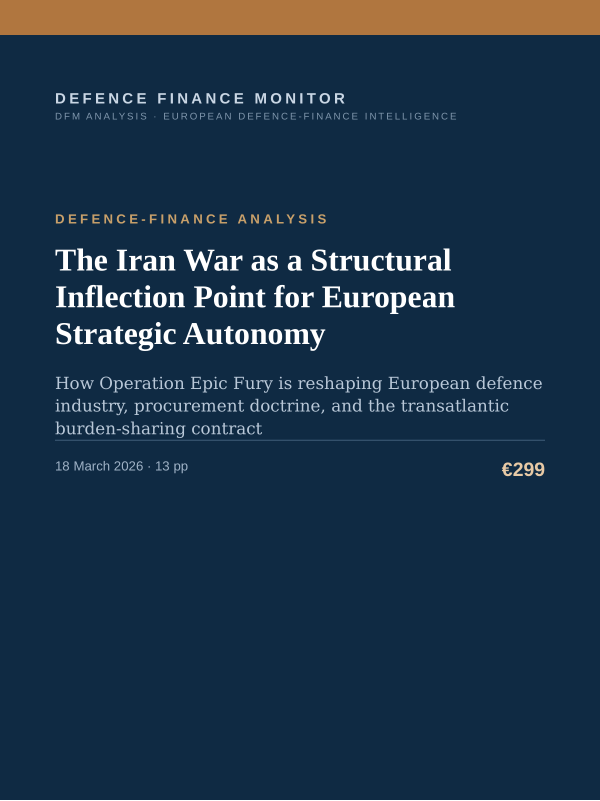 Full sourced report
The Iran War as a Structural Inflection Point for European Strategic Autonomy
View the report →
Full sourced report
The Iran War as a Structural Inflection Point for European Strategic Autonomy
View the report →
Keep getting the analysis
DFM publishes new analysis on Autonomy, Robotics & AI every week.
Original DFM analysis
The Iran War as a Structural Inflection Point for European Strategic Autonomy
The publication details above identify the source used for this public thread.
FAQ
What is The Iran War as a Structural Inflection Point for European Strategic Autonomy?
It has been the subject of summits, white papers, capability pledges, and institutional frameworks that have consistently produced less than the strategic situation demanded.
Why is The Iran War as a Structural Inflection Point for European Strategic Autonomy strategically relevant to European defence?
It is an operational and industrial problem with a measurable gap, a finite set of capable actors, and a delivery timeline that the geopolitical environment is setting whether European governments choose to acknowledge…
Related DFM Platform threads
Explore this category Company Relevance
Professional requests (internal interest signal — not a marketplace; nothing is charged or promised)
See Professional & Institutional Access — plans, group/institutional seats and contact →
Defence Finance Monitor is an analytical and informational product. It does not constitute investment advice, financial advice or a recommendation to buy or sell securities. Subscriptions run on DFM Analysis. Payments for Professional Packs are processed securely by Stripe at checkout.