Capability
Non-Kinetic Counter-UAS with High Power Microwave: Technology, Actors and European Strategic
What capability does non-kinetic counter-UAS address for European defence, and how mature is it against saturation drone threats?
Saturation drone attacks have broken the cost maths of air defence — so how mature are non-kinetic counter-UAS options, and where do they fit for Europe?
This public thread presents the concise analytical answer. The complete evidence, source base and assessment are available below.
Part of our Policy, Procurement & Institutions and Defence & Dual-Use Companies coverage →
Original DFM publication · DFM Analysis report · 2025-07-10
The accelerating proliferation of unmanned aerial systems, from inexpensive quadcopters to increasingly coordinated autonomous swarms, has reshaped the economics and the operational demands of air defence. Conflicts in multiple theatres have demonstrated how saturation attacks by large numbers of low-cost drones can overwhelm traditional kinetic interceptors, creating an unsustainable disparity between the price of the threat and the price required to neutralise it.
The proliferation of cheap, increasingly coordinated drones has created an unsustainable disparity between the price of the threat and the cost of defeating it with traditional kinetic interceptors. Non-kinetic approaches matter because they aim to restore favourable cost-exchange against saturation attacks. The capability question is how mature these options are, how they integrate with existing air defence, and how they perform against adaptive, coordinated swarms rather than single targets. For European defence, affordable layered defence against low-cost mass is becoming a planning priority, because a defence that costs more per engagement than the threat it counters cannot be sustained against sustained attack.
Industrially and financially, the cost-exchange logic drives durable demand, but value will concentrate among solutions that integrate cleanly into layered defence and remain effective as threats adapt. Readers should examine the maturity and limits of non-kinetic effects, how procurement balances them against kinetic options, and which providers can scale production and sustainment. Policy on air defence priorities and spending will shape adoption, and the systems that combine sensing, decision-making and effect into a coherent layer are likelier to endure than point solutions. The deeper question is whether non-kinetic options can keep pace as adversary tactics evolve. The full DFM Analysis report sets out the complete source base, the supporting figures and the detailed assessment behind this view.
Key takeaways
- Industrially and financially, the cost-exchange logic drives durable demand, but value will concentrate among solutions that integrate cleanly into layered defence and remain effective as threats adapt.
- The capability question is how mature these options are, how they integrate with existing air defence, and how they perform against adaptive, coordinated swarms rather than single targets.
- Readers should examine the maturity and limits of non-kinetic effects, how procurement balances them against kinetic options, and which providers can scale production and sustainment.
Choose how to continue
Go deeper on this question
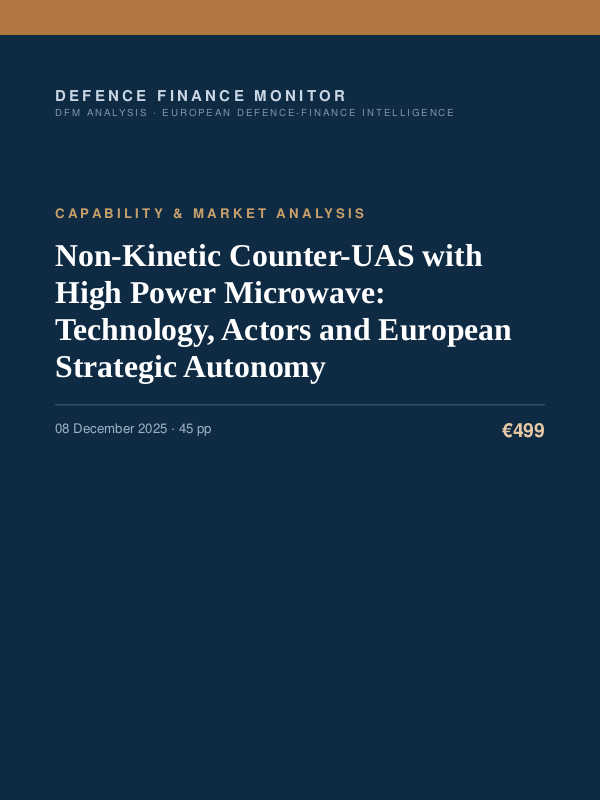 Full sourced report
Non-Kinetic Counter-UAS with High Power Microwave: Technology, Actors and European Strategic Autonomy
View the report →
Full sourced report
Non-Kinetic Counter-UAS with High Power Microwave: Technology, Actors and European Strategic Autonomy
View the report →
Keep getting the analysis
DFM publishes new analysis on Munitions, Missiles & Directed Energy every week.
Original DFM analysis
Defence Finance Monitor Digest 101
The publication details above identify the source used for this public thread.
FAQ
What is Non-Kinetic Counter-UAS with High Power Microwave: Technology, Actors and European Strategic?
The proliferation of cheap, increasingly coordinated drones has created an unsustainable disparity between the price of the threat and the cost of defeating it with traditional kinetic interceptors.
Why does Non-Kinetic Counter-UAS with High Power Microwave: Technology, Actors and European Strategic matter for European defence?
Non-kinetic approaches matter because they aim to restore favourable cost-exchange against saturation attacks.
Related DFM Platform threads
Explore this category Strategic Autonomy
Professional requests (internal interest signal — not a marketplace; nothing is charged or promised)
See Professional & Institutional Access — plans, group/institutional seats and contact →
Defence Finance Monitor is an analytical and informational product. It does not constitute investment advice, financial advice or a recommendation to buy or sell securities. Subscriptions run on DFM Analysis. Payments for Professional Packs are processed securely by Stripe at checkout.