Capability
Japan’s Controlled Exit from Postwar Exceptionalism
Japans Controlled Exit From Postwar: what capability does it address, and how mature is it?
Japan’s defence posture is commonly interpreted through the prism of constitutional restraint and long-standing export prohibitions. This framing is no longer sufficient to capture the structural transformation underway.
This public thread presents the concise analytical answer. The complete evidence, source base and assessment are available below.
Part of our Global Defence Institutions and Defence & Dual-Use Companies coverage →
Original DFM publication · DFM Analysis report · 2025-08-05
Japan’s defence posture is commonly interpreted through the prism of constitutional restraint and long-standing export prohibitions. This framing is no longer sufficient to capture the structural transformation underway. The relevant shift is not ideological but industrial. Over the period from 2014 to 2026, Japan has progressively reconfigured its export-control regime from a near-prohibitive system into a controlled but functional framework that enables participation in allied defence production, co-development, and sustainment.
The key question is therefore not whether Japan has become an unconstrained arms exporter, but whether it has begun to use export liberalisation as an instrument to sustain industrial capacity, expand production scale, and embed itself within allied supply chains. The evidence suggests a gradual but consequential repositioning from a domestically bounded defence producer toward a more outward-facing industrial partner within the Western defence ecosystem. The report is structured to preserve analytical separation across five distinct levels. It first reconstructs the legal-regulatory evolution from the 2014 Three Principles through the 2023 and 2024 revisions to the 2026 developments, establishing the cumulative nature of the shift.
It then analyses the industrial rationale, focusing on production economics, scale, and the sustainability of the defence-industrial base. The third section examines concrete programme evidence, using the Mogami-class frigate and the Global Combat Air Programme as empirical anchors. The fourth section assesses alliance and supply-chain integration, particularly through cooperation with the United States, Australia, United Kingdom, and Italy. The final sections evaluate the implications for procurement markets, competitive dynamics, and supply-chain geography, before identifying the constraints that continue to define Japan’s controlled model of defence export liberalisation.
Japan’s defence-export debate has often been framed as a constitutional or ideological dispute. That framing is now too narrow.
Key takeaways
- The key question is therefore not whether Japan has become an unconstrained arms exporter, but whether it has begun to use export liberalisation as an instrument to sustain industrial capacity, expand production scale…
- It then analyses the industrial rationale, focusing on production economics, scale, and the sustainability of the defence-industrial base.
- Japan’s defence-export debate has often been framed as a constitutional or ideological dispute.
Choose how to continue
Go deeper on this question
 Full sourced report
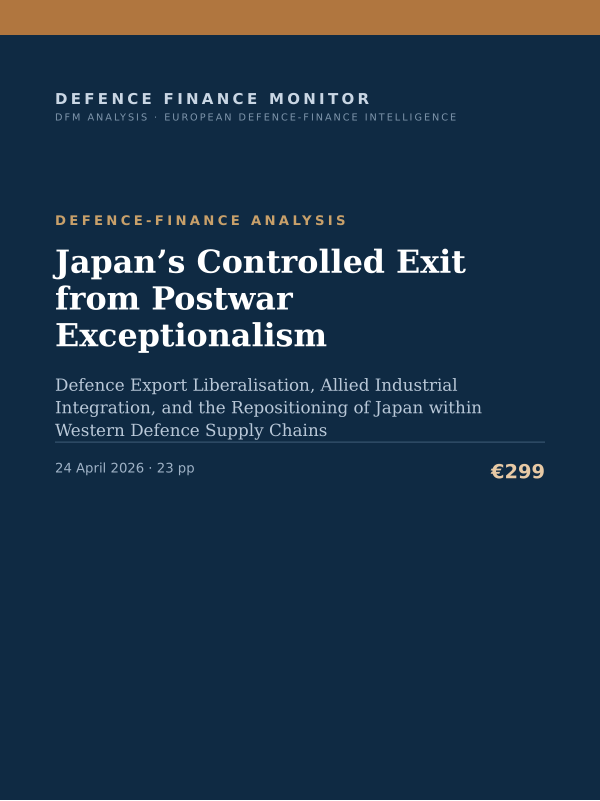
Japan’s Controlled Exit from Postwar Exceptionalism
View the report →
Full sourced report
Japan’s Controlled Exit from Postwar Exceptionalism
View the report →
Keep getting the analysis
DFM publishes new defence-finance analysis every week.
Original DFM analysis
Japans Controlled Exit From Postwar
The publication details above identify the source used for this public thread.
FAQ
What is Japan’s Controlled Exit from Postwar Exceptionalism?
This framing is no longer sufficient to capture the structural transformation underway.
Why does Japan’s Controlled Exit from Postwar Exceptionalism matter for European defence?
The evidence suggests a gradual but consequential repositioning from a domestically bounded defence producer toward a more outward-facing industrial partner within the Western defence ecosystem.
Related DFM Platform threads
Explore this category Strategic Autonomy
Professional requests (internal interest signal — not a marketplace; nothing is charged or promised)
See Professional & Institutional Access — plans, group/institutional seats and contact →
Defence Finance Monitor is an analytical and informational product. It does not constitute investment advice, financial advice or a recommendation to buy or sell securities. Subscriptions run on DFM Analysis. Payments for Professional Packs are processed securely by Stripe at checkout.