Capital Signal
How Rearmament and Disarmament Cycles Shaped Defence Industry Valuations (1945–2025)
What do 80 years of rearmament and disarmament cycles reveal about today's defence-equity valuations?
Policies of rearmament and disarmament since World War II have driven pronounced cycles in military spending that heavily influenced the financial fortunes of major
This public thread presents the concise analytical answer. The complete evidence, source base and assessment are available below.
Part of our Investors & Capital Allocators and Financial Supply-Side coverage →
Original DFM publication · DFM Analysis report · 2025-09-05
Policies of rearmament and disarmament since World War II have driven pronounced cycles in military spending that heavily influenced the financial fortunes of major defence companies. This report traces the period 1945–2025 in the United States and Europe, examining how political decisions on military expenditure translated into market outcomes for key defence firms (e.g. Lockheed Martin, Northrop Grumman, Raytheon, Boeing Defense, BAE Systems, Airbus Defence, Leonardo, Thales, Rheinmetall, Saab). We construct a chronological timeline of arms build-ups and drawdowns, analyze their impact on defence contractors’ valuations and performance, identify recurring patterns (including lags between political shifts and company outcomes), and assess how factors like public opinion, debt and fiscal constraints have moderated these cycles. The goal is to provide a historical framework for investors and decision-makers to understand and anticipate the defence sector’s reaction to political-military cycles.
Post-WWII Demobilization and Early Cold War Rearmament (1945–1955)
After 1945, the Allied nations rapidly demobilized large wartime forces. U.S. military outlays plunged from ~43% of GDP in 1944 to well under 10% by the late 1940s, reflecting a political desire to shift resources to peacetime needs. Defence firms initially struggled with order cancellations and factory closures as the “arsenal of democracy” shrank. However, the Cold War soon spurred rearmament. The outbreak of the Korean War (1950–1953) triggered an abrupt surge in spending: U.S. defense expenditure peaked at 15% of GDP in 1952, its highest post-WWII level, as America and its allies rearmed to contain communism. This first Cold War build-up greatly benefited U.S. aerospace and arms manufacturers – new jet fighters, tanks, and munitions contracts flowed to companies like Lockheed and General Dynamics. The boost to revenues and backlogs lifted defence industry profits and, correspondingly, equity valuations. Many defence stocks outperformed during the Korean War years as military procurement soared.
Key takeaways
- military outlays plunged from ~43% of GDP in 1944 to well under 10% by the late 1940s, reflecting a political desire to shift resources to peacetime needs.
Choose how to continue
Go deeper on this question
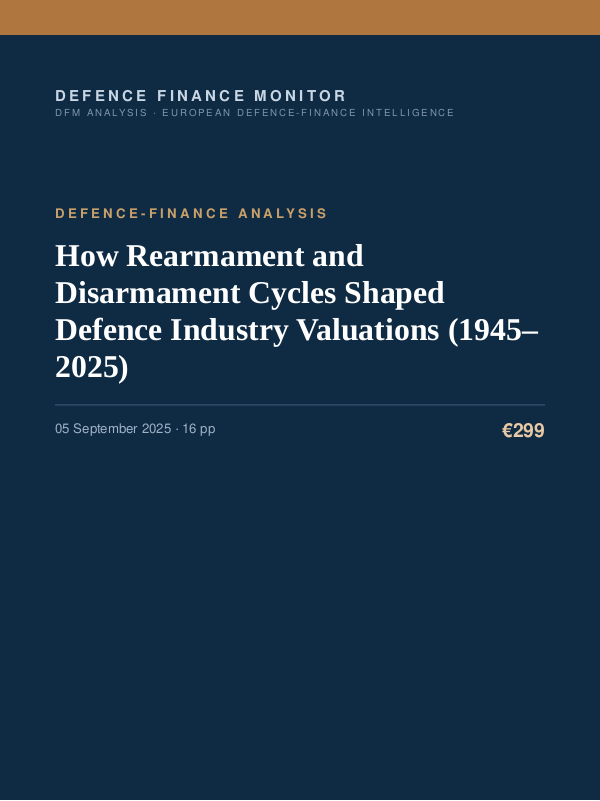 Full sourced report
How Rearmament and Disarmament Cycles Shaped Defence Industry Valuations (1945–2025)
View the report →
Full sourced report
How Rearmament and Disarmament Cycles Shaped Defence Industry Valuations (1945–2025)
View the report →
Keep getting the analysis
DFM publishes new defence-finance analysis every week.
Original DFM analysis
How Rearmament and Disarmament Cycles Shaped Defence Industry Valuations (1945–2025)
The publication details above identify the source used for this public thread.
FAQ
What is How Rearmament and Disarmament Cycles Shaped Defence Industry Valuations (1945–2025)?
Post-WWII Demobilization and Early Cold War Rearmament (1945–1955)
Who can access How Rearmament and Disarmament Cycles Shaped Defence Industry Valuations (1945–2025), and who does it apply to?
After 1945, the Allied nations rapidly demobilized large wartime forces.
Related DFM Platform threads
Explore this category Capital Signals
Professional requests (internal interest signal — not a marketplace; nothing is charged or promised)
See Professional & Institutional Access — plans, group/institutional seats and contact →
Defence Finance Monitor is an analytical and informational product. It does not constitute investment advice, financial advice or a recommendation to buy or sell securities. Subscriptions run on DFM Analysis. Payments for Professional Packs are processed securely by Stripe at checkout.