Capability
Germany–Ukraine Strategic Partnership: The Formation of a Security-Industrial Platform
Germanyukraine Strategic Partnership: what does it mean for European defence capital allocation and valuations?
The strategic partnership agreed between Germany and Ukraine on 14 April 2026 introduces a structural ambiguity that is not reducible to conventional categories of support or alliance-building.
This public thread presents the concise analytical answer. The complete evidence, source base and assessment are available below.
Part of our Policy, Procurement & Institutions and Research, Universities & Deep Tech coverage →
Original DFM publication · DFM Analysis report · 2026-04-14
The strategic partnership agreed between Germany and Ukraine on 14 April 2026 introduces a structural ambiguity that is not reducible to conventional categories of support or alliance-building. Ukraine is simultaneously framed as a recipient of military assistance, a source of battlefield-derived technological adaptation, a co-producer within emerging defence-industrial value chains, and a candidate for progressive integration into the European institutional and economic order. This combination alters the analytical baseline. It suggests that the bilateral relationship is no longer organised around discrete policy domains—defence aid, reconstruction, digital cooperation, accession support—but around an attempt to align them within a single framework in which military capability development, data-driven innovation, industrial recovery, and legal-institutional convergence reinforce one another.
The question is therefore not whether Germany is increasing its support to Ukraine, but whether it is constructing a long-term platform that integrates war-driven capability, industrial transformation, and Europeanisation into a unified design. The report is structured to isolate and then reconnect the layers embedded in the 14 April framework. It begins with a documented baseline that reconstructs the official declaration and annexes, distinguishing rigorously between signed arrangements, identified contracts, stated priorities, and areas subject to further exploration. It then develops an analytical reading that examines the mechanisms linking defence-industrial cooperation, combat-data exchange, digital-state integration, industrial recovery, energy resilience, and EU-oriented institutional alignment.
A third section evaluates implications for four audiences—corporate, financial, regulatory, and sovereign—without collapsing their distinct exposure profiles. The final section identifies specific, time-bound signals that can be used to assess whether the partnership evolves into an operational platform or remains a structured but only partially implemented framework. The contradiction is explicit in the primary text.
Key takeaways
- A third section evaluates implications for four audiences—corporate, financial, regulatory, and sovereign—without collapsing their distinct exposure profiles.
- The report is structured to isolate and then reconnect the layers embedded in the 14 April framework.
- It begins with a documented baseline that reconstructs the official declaration and annexes, distinguishing rigorously between signed arrangements, identified contracts, stated priorities…
Choose how to continue
Go deeper on this question
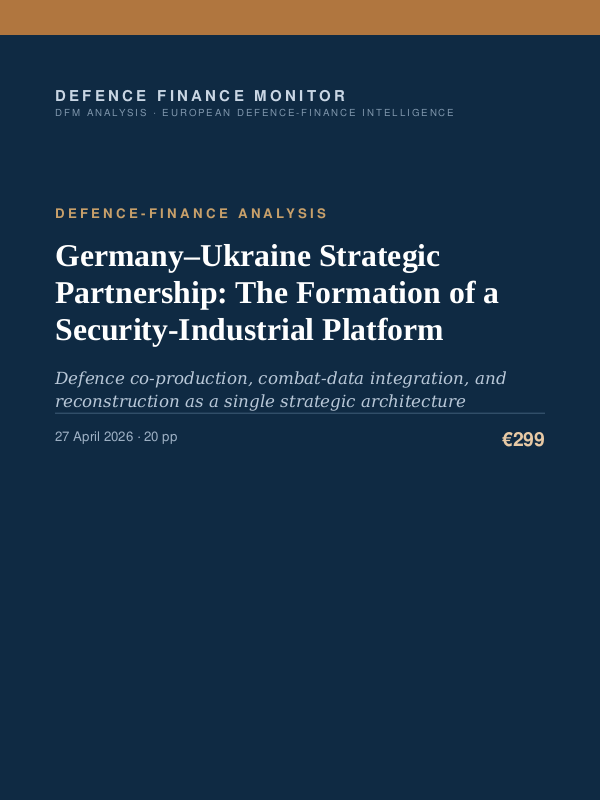 Full sourced report
Germany–Ukraine Strategic Partnership: The Formation of a Security-Industrial Platform
View the report →
Full sourced report
Germany–Ukraine Strategic Partnership: The Formation of a Security-Industrial Platform
View the report →
Keep getting the analysis
DFM publishes new defence-finance analysis every week.
Original DFM analysis
Germanyukraine Strategic Partnership
The publication details above identify the source used for this public thread.
FAQ
What is Germany–Ukraine Strategic Partnership: The Formation of a Security-Industrial Platform?
The question is therefore not whether Germany is increasing its support to Ukraine, but whether it is constructing a long-term platform that integrates war-driven capability, industrial transformation…
Why does Germany–Ukraine Strategic Partnership: The Formation of a Security-Industrial Platform matter for European defence?
It then develops an analytical reading that examines the mechanisms linking defence-industrial cooperation, combat-data exchange, digital-state integration, industrial recovery, energy resilience…
Related DFM Platform threads
Explore this category Strategic Autonomy
Professional requests (internal interest signal — not a marketplace; nothing is charged or promised)
See Professional & Institutional Access — plans, group/institutional seats and contact →
Defence Finance Monitor is an analytical and informational product. It does not constitute investment advice, financial advice or a recommendation to buy or sell securities. Subscriptions run on DFM Analysis. Payments for Professional Packs are processed securely by Stripe at checkout.