Capability
GCAP and FCAS as Two Industrial Governance Models for Sixth-Generation Combat Air
Defence Finance Monitor 179: what capability does it address, and how mature is it?
Defence Finance Monitor applies a top–down method that traces how NATO, EU and allied strategic priorities are translated into regulations, funding lines and procurement programmes, and then into demand for specific
This public thread presents the concise analytical answer. The complete evidence, source base and assessment are available below.
Part of our Policy, Procurement & Institutions and Defence & Dual-Use Companies coverage →
Platform publication · DFM Analysis report · 2026-06-20
Defence Finance Monitor applies a top–down method that traces how NATO, EU and allied strategic priorities are translated into regulations, funding lines and procurement programmes, and then into demand for specific capabilities, technologies and companies. We use official doctrine as the organising frame to identify where strategic relevance is being institutionally defined and where it is materialising in concrete budgets, acquisition pathways and industrial capacity. Our working assumption is that what becomes structurally relevant in NATO/EU strategy tends, over time, to become relevant also from a financial and industrial point of view.
In the European context, this includes the progressive operationalisation of strategic autonomy: the effort to reduce critical dependencies, secure supply chains, strengthen the European defence technological and industrial base, and align regulatory, financial and procurement instruments with long-term security objectives. On this basis, DFM operates as a decision-support tool: it benchmarks investment and industrial choices against institutional demand, clarifies which capabilities are rising on the spending agenda, and maps the funding instruments, eligibility constraints and supply-chain factors that shape real-world feasibility across investors, industry, public authorities and research organisations. Defence Finance Monitor rests on a single analytical premise: within the Euro-Atlantic security architecture, strategic doctrine precedes regulation and capability planning, regulation precedes budgets, and budgets shape markets.
On 2 April 2026, the GCAP Agency placed a £686 million contract with Edgewing and confirmed in official materials that this joint venture will remain design authority for the life of the product — including airworthiness and certification — extending beyond 2070. That single contractual act makes the governance question impossible to avoid: GCAP now has a formally centralised industrial centre of design responsibility within a treaty-backed international organisation.
Choose how to continue
Go deeper on this question
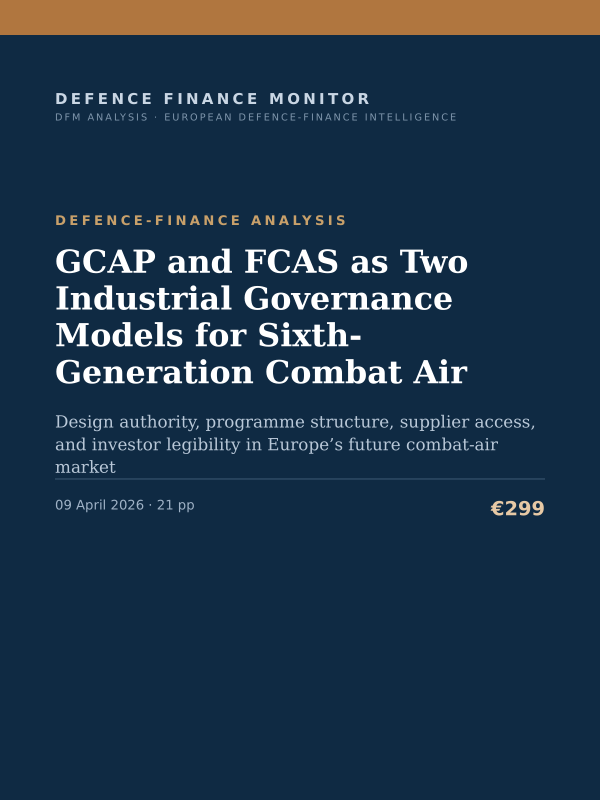 Full sourced report
GCAP and FCAS as Two Industrial Governance Models for Sixth-Generation Combat Air
View the report →
Full sourced report
GCAP and FCAS as Two Industrial Governance Models for Sixth-Generation Combat Air
View the report →
Keep getting the analysis
DFM publishes new analysis on Platforms, Propulsion & Power every week.
Original DFM analysis
Defence Finance Monitor 179
The publication details above identify the source used for this public thread.
Related DFM Platform threads
Explore this category Strategic Autonomy
Professional requests (internal interest signal — not a marketplace; nothing is charged or promised)
See Professional & Institutional Access — plans, group/institutional seats and contact →
Defence Finance Monitor is an analytical and informational product. It does not constitute investment advice, financial advice or a recommendation to buy or sell securities. Subscriptions run on DFM Analysis. Payments for Professional Packs are processed securely by Stripe at checkout.