Capability
FDI Screening and Strategic Control in Europe’s Defence Industry
Fdi Screening and Strategic Control: what does it mean for European defence funding and who can access it?
Europe’s defence sector is entering a phase in which the question is no longer simply whether foreign capital can enter, but under what legal, political, and operational conditions that capital can remain commercially…
This public thread presents the concise analytical answer. The complete evidence, source base and assessment are available below.
Part of our Legal, Regulatory & Advisory and Policy, Procurement & Institutions coverage →
Original DFM publication · DFM Analysis report · 2025-12-11
Europe’s defence sector is entering a phase in which the question is no longer simply whether foreign capital can enter, but under what legal, political, and operational conditions that capital can remain commercially viable once it does. The central tension is that the public and political environment increasingly suggests a progressive closure of the European defence industrial base to non-European ownership, while the binding legal architecture of investment screening remains largely national, fragmented, and only partially harmonised at Union level. This report examines that gap with a strict evidentiary approach and asks whether the real change lies in the FDI screening regime itself, or rather in the parallel emergence of ownership, control, and eligibility constraints embedded in newer defence industrial instruments.
The report is structured in four parts. It begins by reconstructing the legal and institutional baseline from primary sources only, separating binding law in force, legislative proposals not yet applicable, political communications, and national implementation practice in Germany, France, and Italy. It then develops the analytical reading across four issues: the gap between political signalling and operative law, the emergence of EDIP and SAFE as a parallel ownership-control layer, the persistence of fragmentation across Member States, and the practical difference between allied-country capital and adversarial-country capital in real transactions.
The third part assesses the implications for investors, legal advisers, prime contractors, European defence companies, and policymakers. The final part identifies the concrete signals that should be monitored over the next twelve months to determine whether the current fragmented regime is truly hardening into a more restrictive and more centralised system. The structural tension is unchanged but now more consequential.
Choose how to continue
Go deeper on this question
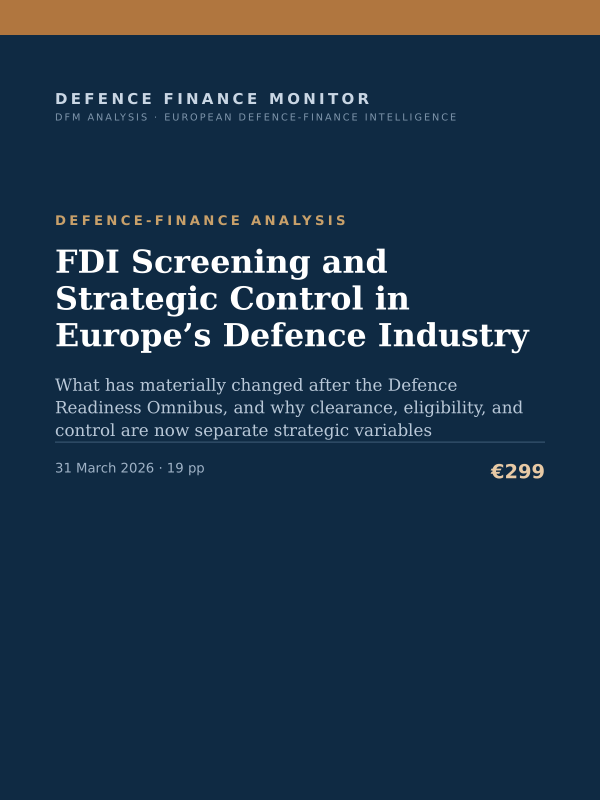 Full sourced report
FDI Screening and Strategic Control in Europe’s Defence Industry
View the report →
Full sourced report
FDI Screening and Strategic Control in Europe’s Defence Industry
View the report →
Keep getting the analysis
DFM publishes new defence-finance analysis every week.
Original DFM analysis
Fdi Screening And Strategic Control
The publication details above identify the source used for this public thread.
Related DFM Platform threads
Explore this category Strategic Autonomy
Professional requests (internal interest signal — not a marketplace; nothing is charged or promised)
See Professional & Institutional Access — plans, group/institutional seats and contact →
Defence Finance Monitor is an analytical and informational product. It does not constitute investment advice, financial advice or a recommendation to buy or sell securities. Subscriptions run on DFM Analysis. Payments for Professional Packs are processed securely by Stripe at checkout.