Capability
Evolving ESG Constraints on Defence and Dual‑Use Investment in Europe
Evolving Esg Constraints on Defence: what does the DFM Analysis cover, and why does it matter for European defence?
Over the past decade, investment in the defence and dual-use technology sectors has shifted from being a marginal and often excluded domain within responsible finance to a contested and structurally regulated area of
This public thread presents the concise analytical answer. The complete evidence, source base and assessment are available below.
Part of our Policy, Procurement & Institutions and Research, Universities & Deep Tech coverage →
Original DFM publication · DFM Analysis report · 2025-03-31
Over the past decade, investment in the defence and dual-use technology sectors has shifted from being a marginal and often excluded domain within responsible finance to a contested and structurally regulated area of capital allocation. European asset managers are no longer dealing with defence merely as an ethical anomaly, but as a complex industrial system embedded in legal obligations, geopolitical realities, and strategic autonomy objectives. This transformation has not resulted in a uniform relaxation of constraints, but rather in the construction of increasingly formalised, rule-based governance frameworks that define when, how, and under which conditions defence-related activities may be considered investable. Revenue thresholds, activity classifications, treaty-based exclusions, and layered due-diligence processes have replaced broad moral prohibitions, producing a differentiated landscape of access to capital.
At the same time, the rise of dual-use technologies such as artificial intelligence, aerospace systems, and advanced electronics has blurred the distinction between civilian and military value chains, complicating ESG risk assessment and investment decisions. Within this context, asset managers are forced to reconcile regulatory compliance, reputational risk, and national security considerations, while investors and policymakers confront the systemic implications of these choices for European defence-industrial resilience and technological sovereignty. European asset managers are moving from broad ethical prohibitions on defence investments toward granular, rules-based ESG frameworks anchored in legal definitions and quantitative criteria. Historically, many ESG funds outright avoided defence stocks as a matter of principle [1] [2] .
This blanket exclusion has given way to more nuanced policies that distinguish what type of defence activity is permissible and how much exposure is tolerated. The change is evident in formal exclusion lists and revenue-based thresholds that asset managers now deploy to operationalize policy.
Key takeaways
- This blanket exclusion has given way to more nuanced policies that distinguish what type of defence activity is permissible and how much exposure is tolerated.
- European asset managers are moving from broad ethical prohibitions on defence investments toward granular, rules-based ESG frameworks anchored in legal definitions and quantitative criteria.
- The change is evident in formal exclusion lists and revenue-based thresholds that asset managers now deploy to operationalize policy.
Choose how to continue
Go deeper on this question
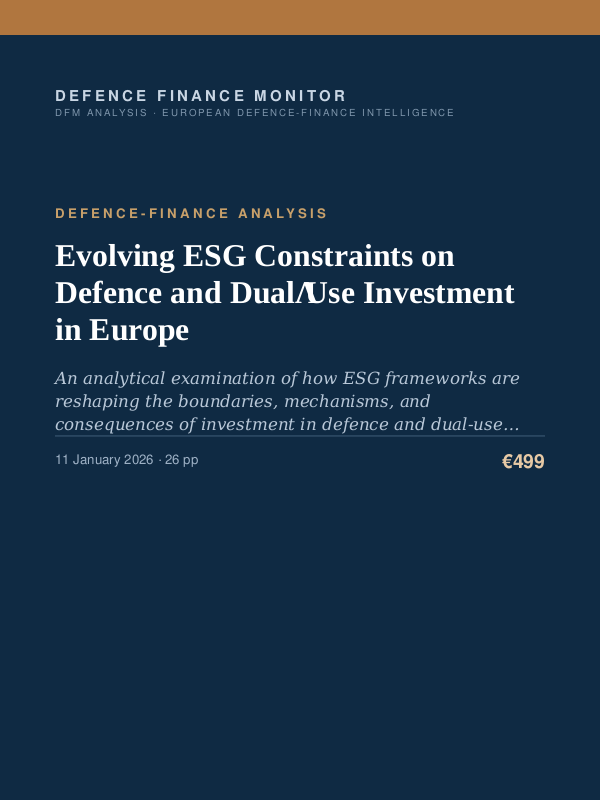 Full sourced report
Evolving ESG Constraints on Defence and Dual‑Use Investment in Europe
View the report →
Full sourced report
Evolving ESG Constraints on Defence and Dual‑Use Investment in Europe
View the report →
Keep getting the analysis
DFM publishes new defence-finance analysis every week.
Original DFM analysis
Evolving Esg Constraints On Defence
The publication details above identify the source used for this public thread.
FAQ
What is Evolving ESG Constraints on Defence and Dual‑Use Investment in Europe?
At the same time, the rise of dual-use technologies such as artificial intelligence, aerospace systems, and advanced electronics has blurred the distinction between civilian and military value chains…
Why does Evolving ESG Constraints on Defence and Dual‑Use Investment in Europe matter for European defence?
Within this context, asset managers are forced to reconcile regulatory compliance, reputational risk, and national security considerations…
Related DFM Platform threads
Explore this category Strategic Autonomy
Professional requests (internal interest signal — not a marketplace; nothing is charged or promised)
See Professional & Institutional Access — plans, group/institutional seats and contact →
Defence Finance Monitor is an analytical and informational product. It does not constitute investment advice, financial advice or a recommendation to buy or sell securities. Subscriptions run on DFM Analysis. Payments for Professional Packs are processed securely by Stripe at checkout.