Capability
European Drone Industrial Autonomy: Strategic De-risking and Component Sovereignty
Defence Finance Monitor 129 Hidden: what capability does it address, and how mature is it?
Defence Finance Monitor is building a comprehensive database that maps companies relevant to European strategic autonomy across the defence and dual-use sectors.
This public thread presents the concise analytical answer. The complete evidence, source base and assessment are available below.
Part of our Policy, Procurement & Institutions and Defence & Dual-Use Companies coverage →
Platform publication · DFM Analysis report · 2026-06-20
Defence Finance Monitor is building a comprehensive database that maps companies relevant to European strategic autonomy across the defence and dual-use sectors. With more than 1,300 European firms now systematically classified, the database is beginning to generate analytically meaningful results. Built on a proprietary methodology combining a closed taxonomy, structured scoring, and evidence-bound analysis, the dataset traces how institutional priorities translate into concrete industrial and technological dependencies. At this level of coverage, it enables the systematic identification of the most critical bottlenecks affecting Europe’s defence and dual-use industrial base, together with the tier-2 and tier-3 hidden champions best positioned to address them.
The emerging evidence indicates that Europe’s strategic autonomy is constrained less by prime contractors than by the intermediate layers of the supply chain, where specialised capabilities, production capacity, and control over key technologies are decisive. This analysis examines the European industrial ecosystem that is progressively replacing Asian-sourced components in the NATO Class 1 drone segment, with a specific focus on the most sensitive and value-critical layers of the system. It maps the transition toward sovereign flight-control architectures, domestically produced propulsion systems, and trusted software stacks operating under full European design authority. The text shows how these firms are addressing both security risks and supply-chain vulnerabilities by localising hardware, firmware, and manufacturing capacity.
Particular attention is given to components that determine resilience in high-attrition and electronically contested environments. The resulting picture is that of a maturing industrial base capable of sustaining autonomous production under wartime conditions. This technical analysis examines the ongoing industrialization of the European defence sector through the lens of the ASAP and SAFE programmes, with specific attention to how these instruments are reshaping production capacity rather than procurement headlines.
Choose how to continue
Go deeper on this question
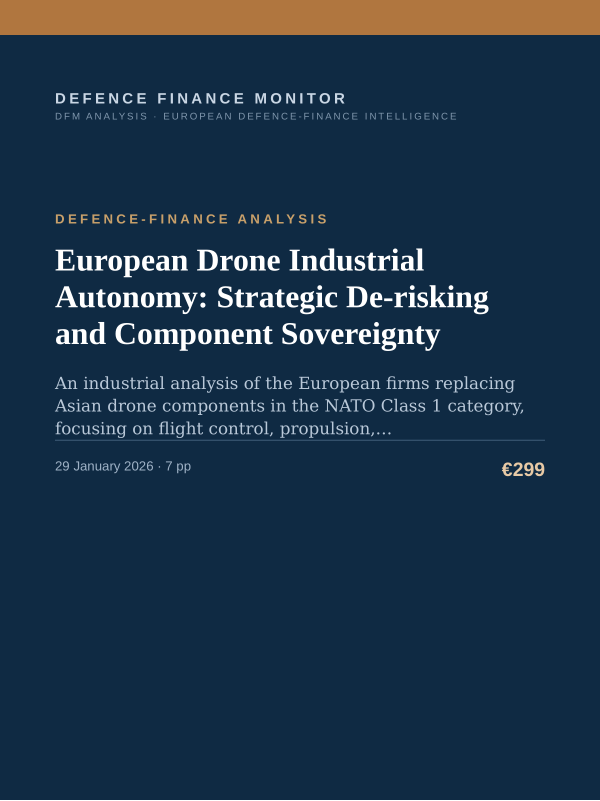 Full sourced report
European Drone Industrial Autonomy: Strategic De-risking and Component Sovereignty
View the report →
Full sourced report
European Drone Industrial Autonomy: Strategic De-risking and Component Sovereignty
View the report →
Keep getting the analysis
DFM publishes new analysis on Autonomy, Robotics & AI every week.
Original DFM analysis
Defence Finance Monitor 129 Hidden
The publication details above identify the source used for this public thread.
Related DFM Platform threads
Explore this category Strategic Autonomy
Professional requests (internal interest signal — not a marketplace; nothing is charged or promised)
See Professional & Institutional Access — plans, group/institutional seats and contact →
Defence Finance Monitor is an analytical and informational product. It does not constitute investment advice, financial advice or a recommendation to buy or sell securities. Subscriptions run on DFM Analysis. Payments for Professional Packs are processed securely by Stripe at checkout.