Capability
Directed Energy Weapons in 2025–2035: Development and Integration in the Military Domain
What does the move of directed energy weapons from prototype toward fielded systems between 2025 and 2035 signal for European defence capital allocation?
Directed energy — high-energy lasers and high-power microwave — is moving from prototype toward fielded capability between 2025 and 2035. What does it signal for capital?
This public thread presents the concise analytical answer. The complete evidence, source base and assessment are available below.
Part of our Research, Universities & Deep Tech and Policy, Procurement & Institutions coverage →
Platform publication · DFM Analysis report · 2026-06-18
Directed Energy Weapons (DEWs) – principally high-energy lasers (HEL) and high-power microwave (HPM) systems – are emerging from decades of R D into operational reality. Between 2025 and 2035, militaries are moving these technologies from prototypes to integrated battlefield systems.
As high-energy lasers and high-power microwave systems move from prototypes toward integrated battlefield systems, the capability question becomes one of maturity, integration and sustainment rather than concept. Directed energy promises a favourable cost-exchange against certain threats, but fielding depends on power, cooling, targeting and integration with existing defences. For European defence the strategic interest lies in whether these systems can complement kinetic options affordably and reliably across the period in which they are expected to transition into service. The challenge is that the engineering constraints around power and integration are exactly the ones that separate a successful demonstration from a system that works dependably in the field.
For capital allocation, a multi-year transition from prototype to fielded capability signals where defence budgets and private investment may concentrate next. Readers tracking valuations and deal flow should examine which parts of the directed-energy stack are defensible, how durable demand forms as systems mature, and how procurement and policy treat a capability still proving itself operationally. The reward favours those who bridge the gap between demonstration and dependable service, and that gap is where both the risk and the eventual value are concentrated. The deeper question is whether the supporting technologies mature quickly enough to meet the expectations now being set. The full DFM Analysis report sets out the complete source base, the supporting figures and the detailed assessment behind this view.
Choose how to continue
Go deeper on this question
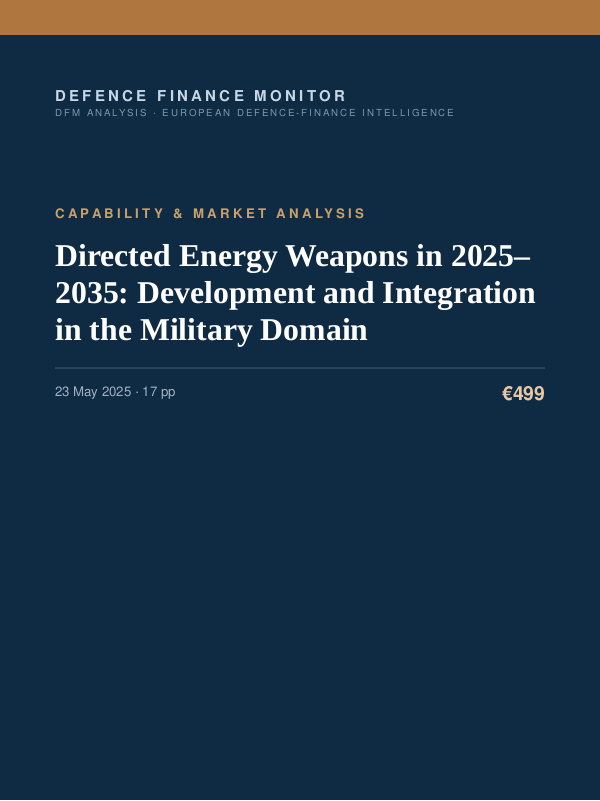 Full sourced report
Directed Energy Weapons in 2025–2035: Development and Integration in the Military Domain
View the report →
Full sourced report
Directed Energy Weapons in 2025–2035: Development and Integration in the Military Domain
View the report →
Keep getting the analysis
DFM publishes new analysis on Munitions, Missiles & Directed Energy every week.
Original DFM analysis
Directed Energy Weapons In 20252035
The publication details above identify the source used for this public thread.
Related DFM Platform threads
Explore this category Strategic Autonomy
Professional requests (internal interest signal — not a marketplace; nothing is charged or promised)
See Professional & Institutional Access — plans, group/institutional seats and contact →
Defence Finance Monitor is an analytical and informational product. It does not constitute investment advice, financial advice or a recommendation to buy or sell securities. Subscriptions run on DFM Analysis. Payments for Professional Packs are processed securely by Stripe at checkout.