Capability
Cogitat Ltd: Advancing Non-Invasive Brain-Computer Interfaces for European Strategic Autonomy
Cogitat Ltd Advancing Non Invasive: what is the technology, and why is it strategically relevant to European defence?
Non-invasive brain-computer interfaces (BCIs) have moved from the realm of sci-fi into real-world innovation, and a small UK-based company is pushing this frontier forward.
This public thread presents the concise analytical answer. The complete evidence, source base and assessment are available below.
Part of our Defence & Dual-Use Companies and Research, Universities & Deep Tech coverage →
Platform publication · DFM Analysis report · 2026-06-20
Non-invasive brain-computer interfaces (BCIs) have moved from the realm of sci-fi into real-world innovation, and a small UK-based company is pushing this frontier forward. Cogitat Ltd , an Imperial College London spin-out founded in 2020, develops AI-driven technology that lets users control computers with mere thoughts [1] . In demonstrations, Cogitat’s system has enabled people to play a jet-ski video game using only brain signals – clenching a virtual throttle with their mind and seeing the on-screen vehicle respond almost instantly [2] . Such feats, achieved through a simple electroencephalography (EEG) headset rather than any surgical implant, highlight the company’s bold promise: to decode brainwaves in a practical, accessible way [3] .
This promise isn’t just about flashy demos; it hints at profound implications. In the civilian world, Cogitat’s technology is already being explored for stroke rehabilitation within the UK’s National Health Service [4] . But the appeal goes further – European defense planners and NATO strategists are taking notice of how BCIs like Cogitat’s could enhance soldier performance and multi-domain operations. Cogitat stands at the intersection of deep tech and defense, crafting non-invasive neural interfaces that align with Europe’s quest for technological autonomy.
By bridging human minds and machines without the need for implants, Cogitat offers a uniquely European approach to a field dominated by U.S. and Chinese players, potentially reducing reliance on foreign neurotechnology [5] . The company’s journey from an academic lab to NATO’s innovation cohort exemplifies how European startups can drive cutting-edge capabilities. It also raises compelling questions: Can a small UK innovator bolster Europe’s strategic autonomy and deterrence by empowering warfighters with thought-controlled systems? And how might such technology help Europe and its allies stay ahead in the global race for cognitive superiority?
These questions make Cogitat a fascinating case study in the strategic-technological landscape, one that piques the interest of technologists and defense analysts alike.
Choose how to continue
Go deeper on this question
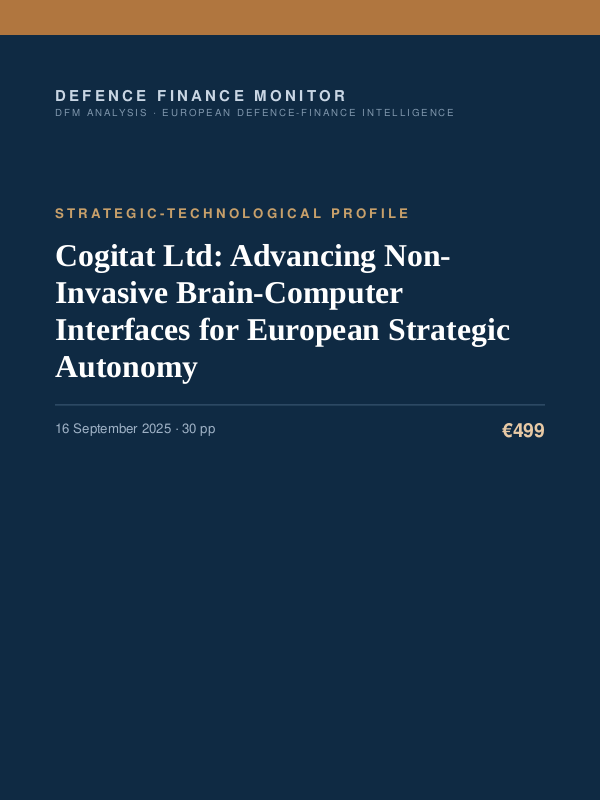 Full sourced report
Cogitat Ltd: Advancing Non-Invasive Brain-Computer Interfaces for European Strategic Autonomy
View the report →
Full sourced report
Cogitat Ltd: Advancing Non-Invasive Brain-Computer Interfaces for European Strategic Autonomy
View the report →
Keep getting the analysis
DFM publishes new analysis on Microelectronics, Quantum & Biotechnology every week.
Original DFM analysis
Cogitat Ltd Advancing Non Invasive
The publication details above identify the source used for this public thread.
Related DFM Platform threads
Explore this category Strategic Autonomy
Professional requests (internal interest signal — not a marketplace; nothing is charged or promised)
See Professional & Institutional Access — plans, group/institutional seats and contact →
Defence Finance Monitor is an analytical and informational product. It does not constitute investment advice, financial advice or a recommendation to buy or sell securities. Subscriptions run on DFM Analysis. Payments for Professional Packs are processed securely by Stripe at checkout.